What Agentic Commerce Means for Shopify Brands (and How to Get Ready)

Your next customer could decide to buy from you without ever browsing your store.

Shopify brands have spent years optimizing the path from an ad or search result to the product page and then to checkout. But AI shopping agents are starting to sit in the middle. They can narrow down products, compare options, check key details, and move a shopper toward purchase before your homepage has a chance to sell anything.

That changes what “conversion-ready” actually means.

In this blog, we’ll look at what agentic commerce changes and what getting agent-ready actually involves.

The buying journey is moving beyond the storefront
What Is Agentic Commerce and How Does It Work for Shopify Brands?

AI search can tell a shopper what to consider. Agentic commerce can help move that shopper toward a transaction.

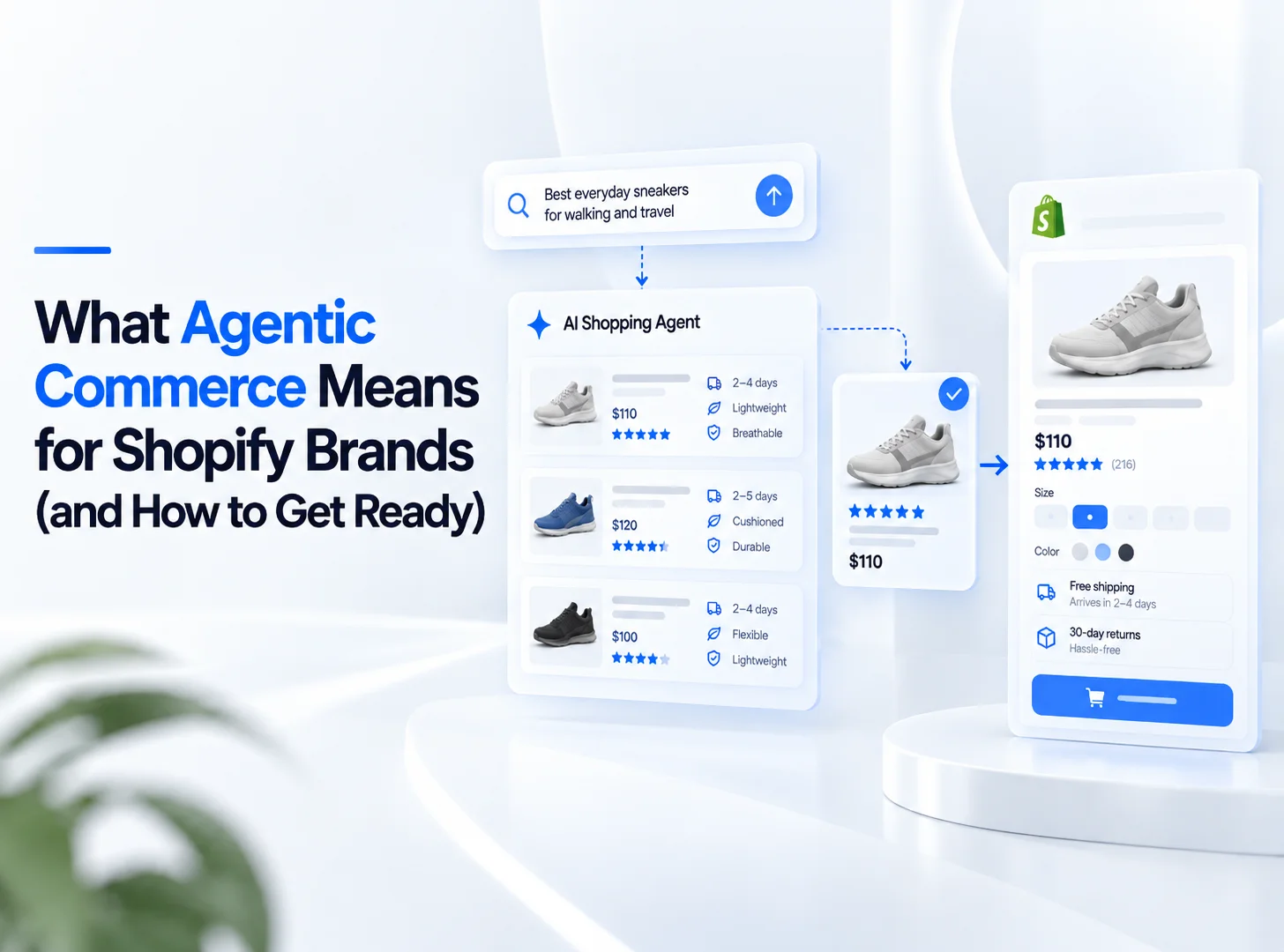
Instead of simply answering, “What are the best running shoes under $150?”, an AI agent can compare products, consider preferences, check current information, and guide the shopper toward checkout.

Shopify describes agentic commerce as a model where AI agents help shoppers discover, compare, and purchase products through conversational experiences. The exact journey varies by platform, but the AI can now become part of the buying path rather than just another place where your brand appears.

AI agents are becoming part of the decision process
AI Shopping Agents Can Influence the Buying Decision Before Your Store

StoreHQ visual showing an AI shopping agent comparing backpacks and guiding a shopper from product selection to Shopify checkout.

Imagine someone asks an AI agent:

“I need a waterproof commuter backpack under $150 that fits a 16-inch laptop and can arrive by Friday.”

Your brand may sell the perfect option. But can the agent tell?

It needs reliable information on price, size, materials, availability, use case, and shipping to determine whether your product is a fit.

Your website still matters, but it may no longer get the first opportunity to persuade the shopper. An AI shopping agent can narrow the consideration set before the shopper reaches you.

Getting your products discovered by AI is only the first step. The next is making sure those systems can actually understand what you sell.

Your product data is becoming your digital shelf
Product Data Is Becoming Your New Storefront

In traditional e-commerce, merchandising is mostly visual. You control the photos, the product copy, reviews, FAQs, and page layout.

An AI agent works with the information it can access and understand.

Shopify Catalog organizes product data so AI can find it more easily, while connected sales channels and feeds help support other agent-based experiences. Shopify says merchants do not need to rebuild their catalog for agentic commerce, although custom data setups can use Catalog Mapping to fine-tune how products are represented.

But completeness matters. If a product description is vague, important details are missing, or variants are not clearly defined, an AI agent has less context to know when your product matches a shopper’s request.

Your product page is still selling to people. The information behind it also needs to be machine-readable.

Conversion now starts before the cart
How AI Agent Checkout Changes Ecommerce Conversion

Once an agent has helped a shopper choose a product, the next question is whether the purchase can keep moving. Price, availability, shipping, and payment options must match what the shopper has already been shown.

If they do not, friction starts before the customer even reaches the cart.

Shopify’s current setup already reflects this. ChatGPT primarily serves as a discovery and referral channel, while supported experiences such as Google AI Mode, Gemini, Microsoft Copilot, and Meta can offer Shopify-powered checkout where available.

AI agent checkout is not just another checkout button. It depends on the systems behind your store staying accurate and in sync.

Preparation starts with a stronger commerce foundation
Is Your Shopify Store Actually Agent-Ready?

You probably do not need an “AI transformation project.” You need a cleaner commerce foundation, starting with a broader ecommerce growth audit of the systems already supporting discovery, conversion, and measurement.

Start by checking the parts of your store an AI agent actually depends on.

  • Review product completeness: Check whether important titles, descriptions, attributes, variants, and use-case details are missing or inconsistent.
  • Check channel access: Confirm which agentic storefronts are active in Shopify and whether the products you want surfaced are eligible.
  • Test transaction readiness: Make sure pricing, inventory, shipping, payment, and policy information stays consistent throughout the buying journey.
  • Review how products appear: Use Shopify’s Agentic tools to preview catalog visibility and identify products that may be poorly represented.
  • Confirm measurement: Check whether AI-driven sessions, referrals, and orders are clearly attributed.

Shopify lets eligible merchants manage AI channel access through the Agentic area of the admin.

Once the setup is in place, the next job is proving whether it is actually driving business.

Visibility alone is no longer enough
Don’t Measure This Like Another SEO Channel

If AI becomes part of the purchase journey, visibility alone is not enough.

You need to know which AI channels are sending shoppers, which products are being surfaced, where orders originate, and whether that traffic converts.

Shopify attributes orders from AI channels by channel or referrer in the admin, allowing brands to separate AI-assisted commerce from the rest of their traffic.

That makes agentic commerce a performance question, not just a visibility question.

Common questions about the next ecommerce shift
Frequently Asked Questions

What is agentic commerce?

Agentic commerce is a shopping model where AI agents help consumers discover, compare, and move toward purchasing products through conversational experiences.

How is agentic commerce different from AI search?

AI search mainly helps users find and evaluate information, while agentic commerce can carry more of the journey from discovery to transaction.

Does Shopify support AI agent checkout?

Yes, Shopify supports agentic storefronts and direct checkout on certain AI channels, although availability and checkout behavior vary by platform and market.

How can Shopify brands prepare for agentic commerce?

Start with accurate product data, reliable commerce information, the right agentic channel settings, and clear AI traffic and order attribution.

The future of commerce depends on readiness
Agentic Readiness Is a Commerce Problem, Not an AI Project

Agentic commerce does not create a completely new growth system. It changes where your existing one needs to work. Your product discovery, merchandising, conversion, and tracking all need to perform well, even when an AI agent helps shape the buying decision before the shopper reaches your store.

The goal is not to chase every new AI feature. It is to make sure your store can perform wherever the buying journey starts next. Get a growth audit with StoreHQ to uncover the gaps that could be limiting discovery, conversion, and agentic readiness.
The Most Expensive Ecommerce Mistakes Founders Make

Most ecommerce stores don’t fail because of a bad product. They fail because of bad decisions made at the wrong time, often with good intentions. The mistakes that drain revenue fastest aren’t always visible at the moment. They show up later, in rising customer acquisition costs, shrinking margins, and stalled growth despite real effort.

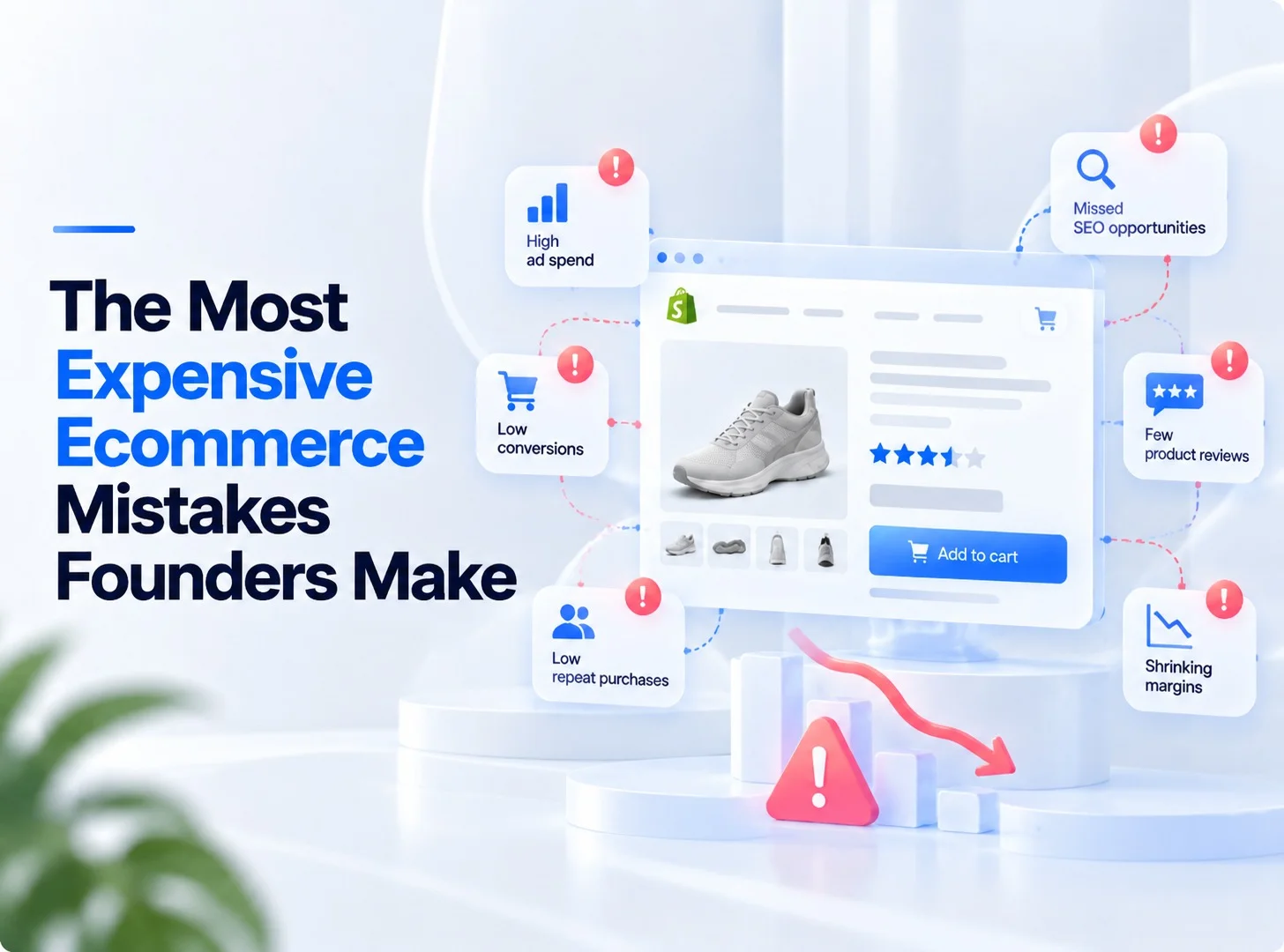
This blog covers the high-stakes errors that consistently hurt ecommerce founders and what each one actually costs.

More spend cannot fix a weak conversion path
Scaling Paid Ads Before Fixing Conversions

Pouring more budget into paid ads before the store converts is one of the fastest ways to burn cash. If the product page is weak, the checkout process has friction, or the offer isn’t clear, then no campaign structure will fix the underlying problem. ROAS suffers not because the targeting is off, but because the destination isn’t doing its job.

CRO isn’t something you revisit after scaling. It’s a prerequisite. Moving the conversion rate from 1.5% to 2.5% on existing traffic changes the economics of every campaign running against the store. Founders who treat optimization as an afterthought pay for it directly in wasted budget and inflated acquisition costs. These are classic ecommerce scaling mistakes that show up fast once spend increases.

The hidden cost of chasing only new customers
Ignoring Retention While Obsessing Over Acquisition

When CAC keeps climbing and the repeat purchase rate stays flat, the business is working harder than it needs to. Acquiring a new customer costs significantly more than selling to an existing one, yet many ecommerce brands have no structured retention strategy beyond a generic newsletter.

The lifecycle flows that drive the most revenue, abandoned cart sequences, post-purchase series, and win-back campaigns, are often missing entirely or set up once and never touched again. That’s money sitting idle. Ignoring retention while chasing new customers is one of the most common ecommerce growth mistakes, and it compounds quietly until CAC becomes unsustainable.

Building growth on rented traffic has limits
Treating SEO as Optional

Over-reliance on paid channels without an organic foundation is an expensive long-term position. Every sale driven purely by ads requires ongoing spend. SEO builds an asset that keeps delivering without a cost per click attached to every visit.

The most common SEO gaps in ecommerce are category pages with thin copy, product descriptions that duplicate manufacturer copy, missing schema markup, and a lack of an internal linking strategy. None of these are complex fixes, but they are constantly deprioritized. Starting SEO late is one of the more avoidable ecommerce marketing mistakes because the compounding nature of search visibility means every month of delay extends how long you’ll keep paying for traffic.

Guesswork is one of the most expensive decisions
Skipping the Data Before Making Big Decisions

Scaling what feels right, rather than what the numbers show, is a pattern that costs ecommerce brands at every stage. Without clear visibility into channel performance, attribution, and product-level margin, budget allocation becomes guesswork. The result is spending more on channels that look productive on the surface but leak margin underneath.

Poor analytics doesn’t just waste budget. It delays pivots that could have entirely changed the business trajectory. Real-time tracking and proper attribution aren’t luxuries for common ecommerce challenges. They’re the difference between decisions that compound and decisions that quietly erode the business. 

This is one of the ecommerce founder mistakes that’s easiest to avoid once the right setup is in place. StoreHQ helps ecommerce founders connect performance data across SEO, paid ads, reviews, retention, and conversion paths so they can see which mistakes are actually costing revenue before they scale the wrong thing. 

A poor experience impacts more than one sale
Underestimating the Cost of a Poor Customer Experience

Slow site speed, confusing navigation, and checkout friction don’t just reduce conversion rate. They reduce LTV because a customer who had a poor first experience rarely comes back. No guest checkout option, limited payment methods, and unclear shipping information are friction points that show up directly as abandoned carts and one-time buyers.

One bad experience hits immediate revenue and long-term review scores at the same time. Customers who leave frustrated don’t write glowing reviews, and negative sentiment on product pages is visible to every future visitor. The cost isn’t just the lost sale. It’s the downstream damage to trust, which is one of the worst ecommerce founder mistakes to recover from.

Trust can decide whether shoppers convert
Neglecting Social Proof and Reviews

Low review volume on high-traffic product pages is a conversion problem, not just a reputation problem. Shoppers use reviews as a decision signal, and a page with few or no reviews creates doubt regardless of how strong the product copy is.

Without a system to generate, manage, and respond to reviews, this gap won’t close on its own. Review generation needs to be a deliberate process built into the post-purchase flow. Responding to reviews, positive and negative, signals credibility to future buyers and affects how platforms surface your products. Treating trust signals as passive reputation management is one of the more common ecommerce growth mistakes, leaving measurable revenue on the table.

Book a demo to find the ecommerce mistakes costing your brand revenue, margin, and repeat customers. 

Answering some common questions
Frequently Asked Questions

What is the most common ecommerce mistake new founders make?

Scaling paid ads before the store is optimized for conversion. Traffic without a converting site burns budget fast.

Why do ecommerce stores with high traffic still struggle to grow?

Usually a retention or CRO problem. Visitors aren’t converting, and buyers aren’t coming back. Both issues compound over time.

When should an ecommerce brand invest in SEO?

From day one, ideally. Category pages and product descriptions should be optimized early. SEO takes time to compound, so starting late means paying for traffic longer.

How do I know if my ecommerce marketing mistakes are hurting revenue?

Rising CAC, flat repeat purchase rate, and low ROAS are the clearest signals. A proper attribution setup makes these patterns visible before they become expensive.

Smarter systems create sustainable growth
Fix the Ecommerce Mistakes That Quietly Drain Growth 

These mistakes are common because they’re easy to deprioritize when the business is moving fast. The fix isn’t doing more across every channel at once. It’s building smarter systems across SEO, CRO, retention, and analytics so each part of the business supports the others.

Get a growth audit with StoreHQ to uncover the ecommerce mistakes costing your brand revenue, margin, and repeat customers. 

How To Tell If Your Store Has a Traffic, Conversion, or Retention Problem

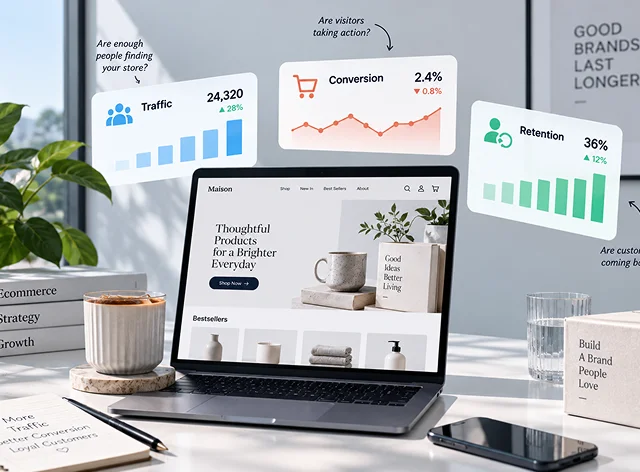
Many e-commerce brands assume the answer is always more traffic. If sales are slow, the instinct is to spend more on ads, launch more campaigns, or chase more reach. But growth problems are not always acquisition problems. Sometimes the store is getting enough visitors and failing to convert them. Sometimes it is converting well but not bringing buyers back. That is why the first step in ecommerce growth is not scaling. It is a diagnosis.

The fastest way to find the real bottleneck is to look at the full customer journey. A store can have strong traffic and still underperform because product pages are weak. It can have solid conversion and still stall because repeat purchases are too low. A simple ecommerce funnel analysis helps you see where the leak is before you spend more money trying to fill it.

The problem is not always where you think it is
Why Ecommerce Growth Problems Are Often Misdiagnosed

A lot of brands misread the symptom as the problem. When revenue slows down, traffic becomes the obvious culprit because it is the easiest metric to watch. Sessions are visible. Ads are visible. Campaigns are visible. But visibility does not mean effectiveness.

This is where brands often waste budget. They increase spend before they understand where customers are dropping off. They add more media, more email sends, or more content without knowing whether the issue is awareness, consideration, or retention. The result is more activity but not necessarily more growth.

The better approach is to diagnose first and scale second. A quarterly growth audit helps identify the bottleneck, then decide which lever matters most. That is usually a better use of time than guessing which channel needs more fuel. It also keeps teams from solving the wrong problem at the wrong stage.

Knowing what is broken changes what you fix
Is Your Problem Traffic or Conversion?

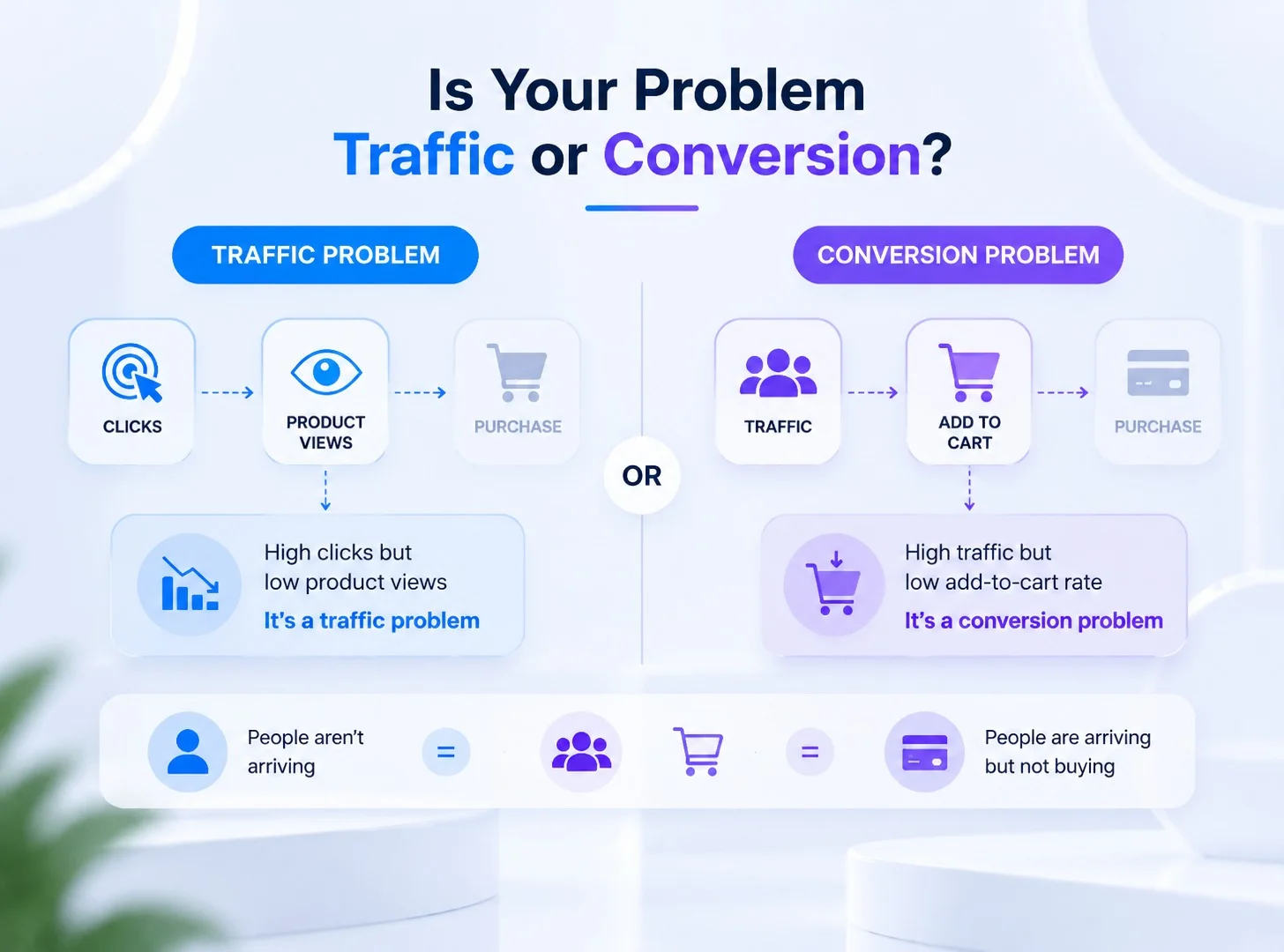
Infographic comparing ecommerce traffic and conversion problems with simple customer journey icons and decision flow.

The clearest way to think about ecommerce traffic vs conversion is to ask whether people are not arriving, or arriving and not buying. Traffic issues happen before qualified visitors reach the store, while conversion issues happen after they land.

A traffic problem usually means low sessions, weak reach, or poor audience fit. A conversion problem means people visit product pages but still do not buy, often because of unclear value, weak trust, or friction in the purchase path.

Here’s a simple test , if clicks are high but product views are low, it is usually traffic. If traffic is strong but add-to-cart rates are weak, it is usually conversion.

Finding the exact point where shoppers drop off
How To Identify Conversion Rate Problems

Conversion rate issues usually become obvious once shoppers start interacting with your store. Common signs include:

  • Low add-to-cart rates despite healthy product page traffic.
  • Unclear product pages that don’t answer key customer questions or communicate value effectively.
  • Confusing pricing or shipping costs that reduce purchase intent.
  • Checkout friction, such as mandatory account creation, lengthy forms, or limited payment options.
  • Poor mobile experience, including difficult navigation, slow load times, or hard-to-use checkout flows.
  • High cart or checkout abandonment, indicating trust or usability issues.
  • Weak trust signals, such as missing reviews, guarantees, return policies, or security badges.
  • Paid campaigns with low conversion rates, where traffic arrives but fails to generate sales.
  • Creative fatigue in ads, shown by declining CTR, rising CPMs, and lower engagement.

Tip: Follow the customer journey from product view → add to cart → checkout → purchase. The stage with the biggest drop-off usually reveals where your conversion problem lies.

Acquiring customers is only one part of growth
Why Retention Problems Can Limit Ecommerce Growth

Retention is often the most underestimated part of ecommerce growth. A store can win the first sale and still struggle if customers never come back.

If repeat purchases are weak, the business has to keep replacing lost buyers, which puts more pressure on paid channels and acquisition efficiency. Over time, that makes growth more expensive and less stable.

That is why customer lifetime value matters so much. A store with strong retention grows more efficiently because each customer is worth more over time. Retention issues usually show up when first-time buyers convert but do not become repeat buyers, often because the post-purchase experience or follow-up is too weak.

Building a system that brings customers back
Building A Strong Ecommerce Retention Strategy

An effective retention strategy focuses on delivering relevant, timely experiences that encourage customers to return. Key elements include:

  • Personalized email and SMS campaigns based on customer behavior and purchase history.
  • Welcome flows that introduce your brand and set clear expectations.
  • Post-purchase sequences that build confidence, provide support, and encourage repeat purchases.
  • Replenishment reminders for products customers are likely to reorder.
  • Reactivation campaigns to win back inactive customers with relevant offers or content.
  • Customer segmentation based on purchase frequency, product type, and shopping behavior.
  • Simple, valuable loyalty programs that reward repeat purchases without unnecessary complexity.
  • Product education and helpful content that keeps customers engaged after their first order.
  • Consistent post-purchase experience, including excellent service, timely communication, and ongoing value.

A successful retention strategy keeps customers engaged long after their first purchase, increasing customer lifetime value and reducing reliance on constant customer acquisition.

Match your strategy to your biggest constraint
How To Decide What Your Store Actually Needs

The decision becomes easier when you look at the pattern of the business instead of a single metric. If you have very low traffic, the problem is likely acquisition. If you have traffic but weak sales, the problem is likely conversion. If you have sales but poor repeat purchase behavior, the problem is likely retention.

This is where the right growth approach matters. Broader guidance can help, but only after you know which part of the funnel needs attention first. A store that lacks traffic should not spend its energy on checkout optimization alone. A store with plenty of visitors but weak sales should not keep buying more traffic before fixing the product experience. A store with repeat buyers but weak acquisition may need stronger discovery and visibility.

The point is to match the fix to the bottleneck. That is what makes ecommerce conversion rate optimization effective in practice. It is not just about improving the rate. It is about improving the part of the journey that is limiting the store’s growth right now.

A simple rule helps. If visitors are coming but not buying, focus on conversion. If buyers are coming back too rarely, focus on retention. If people are not arriving at all, focus on traffic. Once that diagnosis is clear, every next decision gets easier.

Fix the bottleneck before scaling further
Conclusion

Most stores do not have a single growth problem. They have one dominant bottleneck that keeps showing up first. Some stores need more traffic. Some need stronger conversion. Others need a better retention system. The job is not to guess. The job is to identify where the leak is and fix that stage before adding more pressure to the rest of the funnel.

That is why ecommerce funnel analysis should sit at the center of your decision-making. It helps you see whether the issue is traffic, conversion, or retention, and it keeps you from overspending on the wrong lever. More advanced perspectives on quarterly growth audits reinforce the same idea: diagnose cleanly, then scale with intent. When you do that, ecommerce conversion rate optimization becomes a growth system, not just a tactic.

Ready to scale smarter? Get a growth audit with StoreHQ and turn your optimization process into a consistent competitive advantage.