Your next customer could decide to buy from you without ever browsing your store.
Shopify brands have spent years optimizing the path from an ad or search result to the product page and then to checkout. But AI shopping agents are starting to sit in the middle. They can narrow down products, compare options, check key details, and move a shopper toward purchase before your homepage has a chance to sell anything.
That changes what “conversion-ready” actually means.
In this blog, we’ll look at what agentic commerce changes and what getting agent-ready actually involves.
What Is Agentic Commerce and How Does It Work for Shopify Brands?
AI search can tell a shopper what to consider. Agentic commerce can help move that shopper toward a transaction.
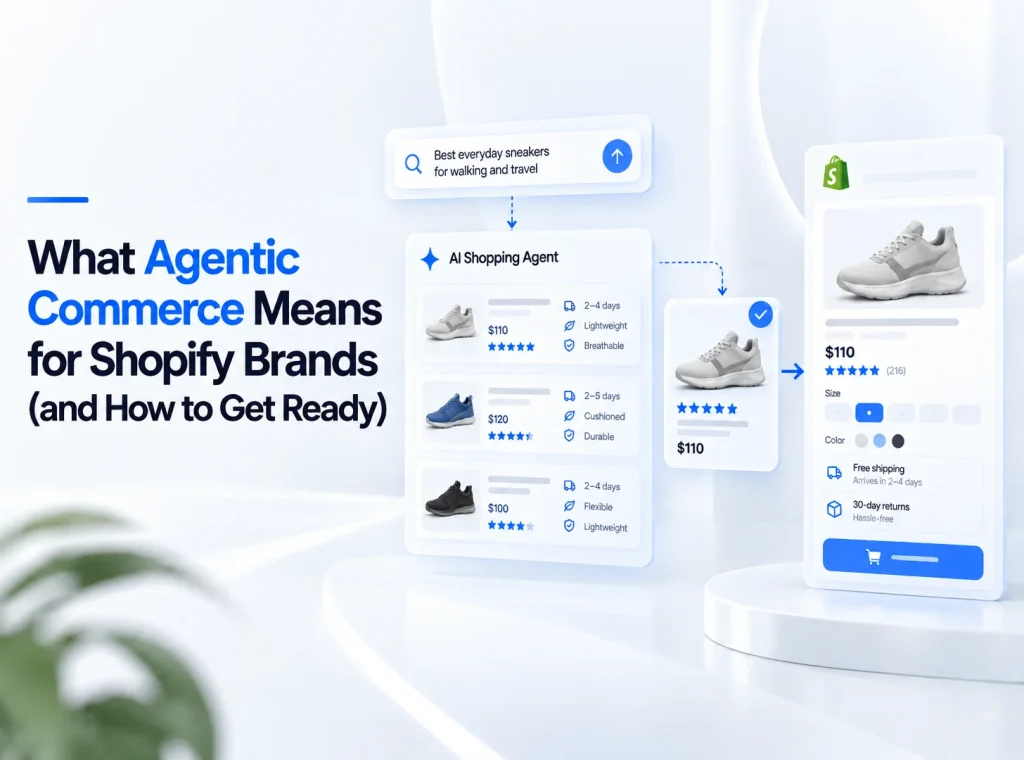
Instead of simply answering, “What are the best running shoes under $150?”, an AI agent can compare products, consider preferences, check current information, and guide the shopper toward checkout.
Shopify describes agentic commerce as a model where AI agents help shoppers discover, compare, and purchase products through conversational experiences. The exact journey varies by platform, but the AI can now become part of the buying path rather than just another place where your brand appears.
AI Shopping Agents Can Influence the Buying Decision Before Your Store

Imagine someone asks an AI agent:
“I need a waterproof commuter backpack under $150 that fits a 16-inch laptop and can arrive by Friday.”
Your brand may sell the perfect option. But can the agent tell?
It needs reliable information on price, size, materials, availability, use case, and shipping to determine whether your product is a fit.
Your website still matters, but it may no longer get the first opportunity to persuade the shopper. An AI shopping agent can narrow the consideration set before the shopper reaches you.
Getting your products discovered by AI is only the first step. The next is making sure those systems can actually understand what you sell.
Product Data Is Becoming Your New Storefront
In traditional e-commerce, merchandising is mostly visual. You control the photos, the product copy, reviews, FAQs, and page layout.
An AI agent works with the information it can access and understand.
Shopify Catalog organizes product data so AI can find it more easily, while connected sales channels and feeds help support other agent-based experiences. Shopify says merchants do not need to rebuild their catalog for agentic commerce, although custom data setups can use Catalog Mapping to fine-tune how products are represented.
But completeness matters. If a product description is vague, important details are missing, or variants are not clearly defined, an AI agent has less context to know when your product matches a shopper’s request.
Your product page is still selling to people. The information behind it also needs to be machine-readable.
How AI Agent Checkout Changes Ecommerce Conversion
Once an agent has helped a shopper choose a product, the next question is whether the purchase can keep moving. Price, availability, shipping, and payment options must match what the shopper has already been shown.
If they do not, friction starts before the customer even reaches the cart.
Shopify’s current setup already reflects this. ChatGPT primarily serves as a discovery and referral channel, while supported experiences such as Google AI Mode, Gemini, Microsoft Copilot, and Meta can offer Shopify-powered checkout where available.
AI agent checkout is not just another checkout button. It depends on the systems behind your store staying accurate and in sync.
Is Your Shopify Store Actually Agent-Ready?
You probably do not need an “AI transformation project.” You need a cleaner commerce foundation, starting with a broader ecommerce growth audit of the systems already supporting discovery, conversion, and measurement.
Start by checking the parts of your store an AI agent actually depends on.
- Review product completeness: Check whether important titles, descriptions, attributes, variants, and use-case details are missing or inconsistent.
- Check channel access: Confirm which agentic storefronts are active in Shopify and whether the products you want surfaced are eligible.
- Test transaction readiness: Make sure pricing, inventory, shipping, payment, and policy information stays consistent throughout the buying journey.
- Review how products appear: Use Shopify’s Agentic tools to preview catalog visibility and identify products that may be poorly represented.
- Confirm measurement: Check whether AI-driven sessions, referrals, and orders are clearly attributed.
Shopify lets eligible merchants manage AI channel access through the Agentic area of the admin.
Once the setup is in place, the next job is proving whether it is actually driving business.
Don’t Measure This Like Another SEO Channel
If AI becomes part of the purchase journey, visibility alone is not enough.
You need to know which AI channels are sending shoppers, which products are being surfaced, where orders originate, and whether that traffic converts.
Shopify attributes orders from AI channels by channel or referrer in the admin, allowing brands to separate AI-assisted commerce from the rest of their traffic.
That makes agentic commerce a performance question, not just a visibility question.
Frequently Asked Questions
What is agentic commerce?
Agentic commerce is a shopping model where AI agents help consumers discover, compare, and move toward purchasing products through conversational experiences.
How is agentic commerce different from AI search?
AI search mainly helps users find and evaluate information, while agentic commerce can carry more of the journey from discovery to transaction.
Does Shopify support AI agent checkout?
Yes, Shopify supports agentic storefronts and direct checkout on certain AI channels, although availability and checkout behavior vary by platform and market.
How can Shopify brands prepare for agentic commerce?
Start with accurate product data, reliable commerce information, the right agentic channel settings, and clear AI traffic and order attribution.
Agentic Readiness Is a Commerce Problem, Not an AI Project
Agentic commerce does not create a completely new growth system. It changes where your existing one needs to work. Your product discovery, merchandising, conversion, and tracking all need to perform well, even when an AI agent helps shape the buying decision before the shopper reaches your store.
The goal is not to chase every new AI feature. It is to make sure your store can perform wherever the buying journey starts next. Get a growth audit with StoreHQ to uncover the gaps that could be limiting discovery, conversion, and agentic readiness.

 6 min read