Should You Let AI Crawlers Into Your Store? robots.txt, llms.txt, and the Trade-Offs

AI bots are reading your product pages right now. Most Shopify owners never notice because these visits rarely show up as sessions in analytics.

Controlling them is where people get confused. One guide says to block everything. Another says llms.txt handles it. Neither file works the way most store owners assume.

This guide explains how AI crawlers handle robots.txt rules, where llms.txt fits, and how to choose which bots to allow.

AI discovery can begin before a shopper reaches your site
Why AI Crawlers Are Already Visiting Your Store

Shoppers ask ChatGPT, Perplexity, and Gemini things like “best running shoes for flat feet under $150.” The assistant replies with brands, prices, and links. If your store isn’t in that answer, you could miss a sale before the shopper opens Google.

That makes AI crawlers part of how shoppers discover products. When AI search tools can access your product pages, they have another way to find and reference your store.

Making your pages accessible is only part of the process. Clear product descriptions, structured data, and answers to common buyer questions also help AI systems understand what you’re selling.

Shopify’s default robots.txt keeps crawlers out of certain cart, checkout, and internal paths. Its rules can also affect AI crawlers, so check what your store currently allows before making changes.

Not every crawler serves the same purpose
Not Every AI Bot Wants the Same Thing From You

AI companies run separate bots for separate jobs:

  • Training crawlers collect content to help build future models. Their purpose isn’t to send referral traffic.
  • Search and retrieval bots discover pages so AI answers can reference or cite them, sometimes with a link.
  • User-triggered bots fetch a page live when someone asks about it.

OpenAI’s official crawler documentation explains the split clearly. The GPTBot user agent gathers training data. OAI-SearchBot powers ChatGPT search, and ChatGPT-User fetches pages during user requests.

Blocking GPTBot opts your content out of OpenAI’s training crawls. Blocking OAI-SearchBot prevents your pages from appearing in ChatGPT search results, although they may still appear as navigational links.

Crawler control starts with knowing what the rules actually do
What robots.txt Can and Can’t Control

robots.txt works through user-agent rules. You name a bot, then allow or disallow paths.

This rule keeps OpenAI’s training crawler off your entire site:

User-agent: GPTBot

Disallow: /

The catch is compliance. robots.txt makes a request. It doesn’t lock anything. OpenAI, Anthropic, and Google document crawler controls, but anonymous scrapers may ignore them.

You can block GPTBot without directly affecting your Google rankings. Googlebot runs separately, so that rule has no direct effect on organic search.

Google-Extended trips people up. Blocking it restricts certain Gemini-related uses of your content, including training and grounding. Google AI Overviews, however, use Google Search crawling and indexing controls. You can’t use a separate robots.txt rule to block only Google AI Overviews. Google provides other controls to limit how your content appears in Search.

Editing robots.txt.liquid in Shopify

Shopify generates a robots.txt file automatically. To customize it, go to Online Store, then Themes, and select Edit code. You can then create a robots.txt.liquid template in the Templates folder. Make sure to preserve Shopify’s default rules when making changes.

Small edits cause most of the damage:

  • A Disallow: / under User-agent: * that blocks every bot, Googlebot included.
  • A copied “block all AI” list that includes OAI-SearchBot or PerplexityBot.
  • Deleting Shopify’s default Liquid loop and losing its cart and checkout rules.

If you’re unsure what your file allows, a broader ecommerce website audit can help identify crawlability, indexing, and other technical SEO issues.

Guidance and access control are two different things
Where llms.txt Fits and Why It Doesn’t Block Anything
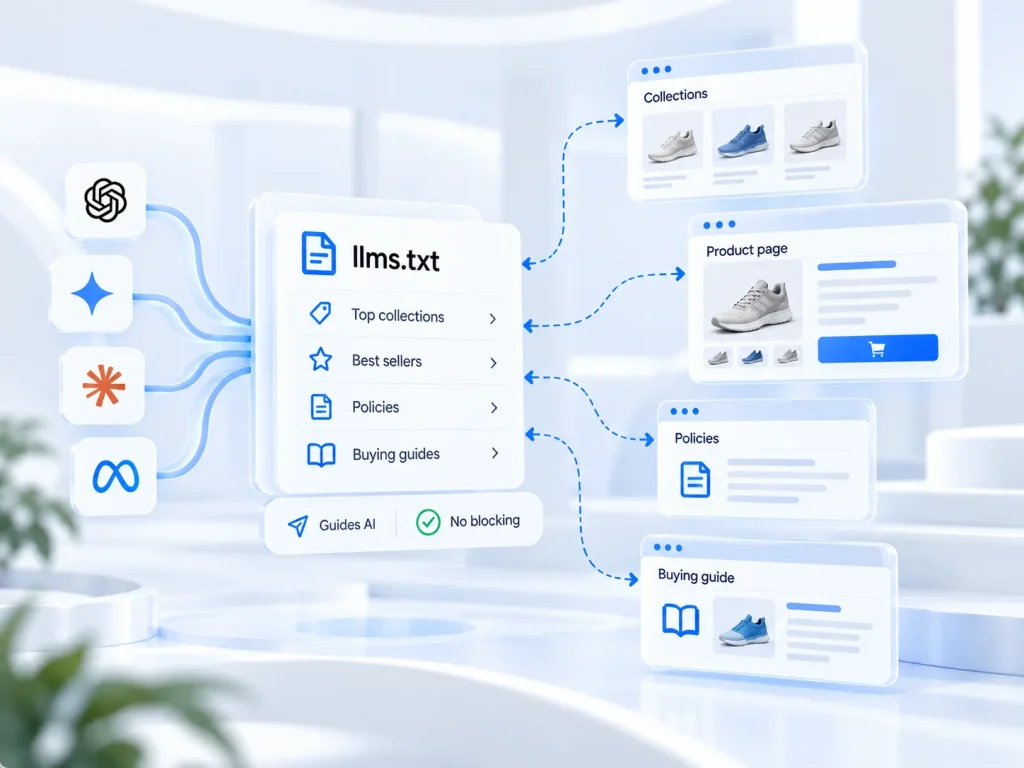
StoreHQ illustration showing how llms.txt guides AI tools to Shopify product pages, collections, policies, and buying guides.

llms.txt is a Markdown-formatted file served at your domain root. It gives language models a curated map of your most useful pages. It controls no access at all.

Jeremy Howard proposed the format in 2024, and it’s still a proposal. Major AI platforms haven’t established llms.txt as a standard requirement for appearing in their answers. Treat it as useful preparation, not a guarantee of visibility.

Shopify now generates an llms.txt file automatically. Most stores can use the default version without making changes. If you need to customize it, you can add an llms.txt.liquid template through your theme’s code editor.

For a store, prioritize pages like your top collections, best-selling products, shipping and returns policies, and size or buying guides.

The right setup depends on what you want AI to access
How to Decide What to Allow in Your Store

You don’t need to block every AI bot. The better approach is to choose which ones can access your store.

Allow search bots like OAI-SearchBot and PerplexityBot if you want your products to appear in AI search results. You can block GPTBot if you don’t want your content used for AI training.

Also, check your store’s security settings. Sometimes they block AI bots even when your robots.txt allows them.

To see whether AI search is bringing visitors, check GA4 for traffic from ChatGPT, Perplexity, and Gemini. To see which bots are visiting your store, check your server or CDN logs.

You can also learn how AI discoverability works across different platforms and what helps your products appear in relevant searches.

Common questions about controlling AI crawler access
Frequently Asked Questions 

Will blocking GPTBot hurt my Google rankings?

No. GPTBot and Googlebot run separately, so blocking GPTBot has no direct effect on Google Search.

Does llms.txt stop AI bots from crawling my store?

No. llms.txt provides guidance, while robots.txt and bot protection settings help manage crawler access.

What is the GPTBot user agent used for?

OpenAI uses GPTBot to collect training data. OAI-SearchBot handles search crawling, while ChatGPT-User handles user-triggered requests.

Can I add llms.txt to a Shopify store?

Yes. Shopify generates llms.txt automatically, and you can customize it through your theme’s code editor.

How do I know if AI tools send traffic to my store?

Look for AI platforms in your GA4 referral sources. Server or CDN logs can help identify crawler visits.

Make crawler access a deliberate visibility decision
Make AI Crawler Access Work for Your Store

AI access shapes your visibility, and leaving your settings unchecked means you may not know which bots can reach your content. Pick each bot on purpose.

Your crawler settings can influence how AI tools discover your products. Making those choices deliberately gives your store a better starting point for AI visibility.

Not sure whether your Shopify store is ready for AI search? Get a free growth audit from StoreHQ to identify technical SEO gaps and opportunities to improve your store’s discoverability.

Paid Ads vs. SEO vs. Email: Where Should Your Next Marketing Dollar Actually Go?

Your Shopify store is getting traffic. Paid campaigns are running. Email is bringing in some sales. SEO is starting to gain traction.

Then comes the harder question: where should the next chunk of your marketing budget actually go?

Putting more money into the wrong channel can leave you with more clicks, more activity, and very little extra revenue. Good marketing budget allocation for ecommerce starts with knowing which part of your growth system needs help most right now.

In this blog, you’ll learn when paid ads deserve more budget, when SEO is the smarter investment, when email should take priority, and how to decide which channel can make the biggest difference to your Shopify growth.

Speed matters when you need qualified visitors
Paid Ads Make Sense When You Need More Qualified Traffic

Paid media can be one of the fastest ways to put your products in front of the right audience.

For a Shopify brand with a proven offer, a website that converts, and reliable tracking, increasing ad spend can help you reach more customers without waiting months for another channel to build momentum.

The problem starts when brands use paid ads to compensate for issues elsewhere.

If shoppers land on weak product pages, struggle through checkout, or do not understand why they should buy, more traffic simply sends more people into the same broken experience.

Once the fundamentals are working, better audience targeting, creative testing, and budget allocation can help you scale paid acquisition more efficiently instead of simply increasing spend.

Paid media is ready for more budget when:

  • Your product pages are converting consistently.
  • Your tracking and attribution are reliable.
  • You know which products, audiences, and campaigns drive profitable orders.
  • Your creative is being tested and refreshed regularly.

The goal is to buy traffic that can turn into profitable revenue.

Build visibility that does not depend only on spend
SEO Makes Sense When Paid Traffic Is Doing Too Much of the Work

StoreHQ visual comparing paid ads, SEO, and email as three ways to allocate ecommerce marketing budget.

People think PPC is fast and SEO is slow. That is true, but not entirely.

Paid ads can generate demand as long as you continue funding them. SEO helps you build visibility that can keep bringing qualified shoppers to your store over time.

For ecommerce brands, that includes much more than publishing blog posts. Collection pages, product pages, technical SEO, internal linking, structured data, site speed, and search intent all influence how easily shoppers can find you.

When those pieces work together, organic search can become a scalable acquisition channel rather than just another source of traffic.

SEO may deserve more of the budget when:

  • Organic traffic has stopped growing.
  • Important product or collection pages have weak visibility.
  • Most new customer acquisition depends on paid campaigns.
  • Technical SEO issues are limiting rankings or discoverability.

Waiting until paid acquisition becomes too expensive is usually the wrong time to start building an organic channel.

Growth does not stop after the first purchase
Email Makes Sense When You Are Winning Customers but Not Keeping Them

Paid ads and SEO help shoppers discover your brand. Email helps you get more value from the customers and prospects you already worked to acquire.

That matters because a store can generate plenty of first-time orders and still struggle to grow.

If customers rarely return, the business has to keep replacing them with new buyers. That puts more pressure on acquisition and makes growth harder to maintain.

Email deserves closer attention when:

  • Key flows such as welcome, abandoned cart, post-purchase, or win-back are weak.
  • Repeat purchase rates are not improving.
  • Most subscribers receive the same messages.
  • Revenue depends heavily on constantly acquiring new customers.

The right investment depends on the real constraint
So, Where Should Your Next Marketing Dollar Go?

There is no single winner in a marketing channel comparison between paid ads, SEO, and email.

The best channel depends on where the customer journey is breaking down.

If you are not getting enough qualified visitors, acquisition needs attention.

If traffic is healthy but sales are weak, putting more money into traffic may make little sense until conversion improves.

If traffic is healthy but sales are still weak, it may be time to fix the storefront issues hurting conversion before spending more on acquisition. Slow pages, unclear product information, poor mobile UX, and checkout friction can all reduce the value of traffic you are already paying for.

If customers are buying but rarely returning, retention may offer a better opportunity than another acquisition campaign.

This is the simplest way to think about where to spend a marketing budget for a Shopify store: put the next dollar where it can remove the biggest constraint.

Not where competitors are spending.

Not where the latest marketing trend says you should spend.

Where your own numbers show the biggest gap.

Common questions about channel investment decisions
Frequently Asked Questions

Which marketing channel should ecommerce brands invest in first?

Start with the channel that solves your biggest current growth problem, whether that is traffic, conversion, or retention.

Is SEO better than paid ads for ecommerce?

Neither is always better; paid ads offer speed, while SEO can build more durable organic visibility over time.

How much should a Shopify store spend on paid ads?

There is no universal amount, so base spend on your margins, conversion performance, CAC, and ability to scale profitably.

When should an ecommerce brand invest more in email marketing?

Increase investment when you have customers and subscribers but weak repeat purchases, lifecycle flows, or segmentation.

Should SEO, paid ads, and email be managed separately?

They can have separate tactics, but budget decisions should consider how all three channels affect the same customer journey.

Put budget behind the biggest opportunity
Put Your Next Marketing Dollar Where It Matters Most

Paid ads, SEO, and email can all drive growth, but the right investment depends on what your store needs now. Find the biggest gap first, then put your budget behind the channel most likely to improve it.

Not sure where your next dollar should go? Start a conversation and get a clearer view of what is holding your Shopify growth back.

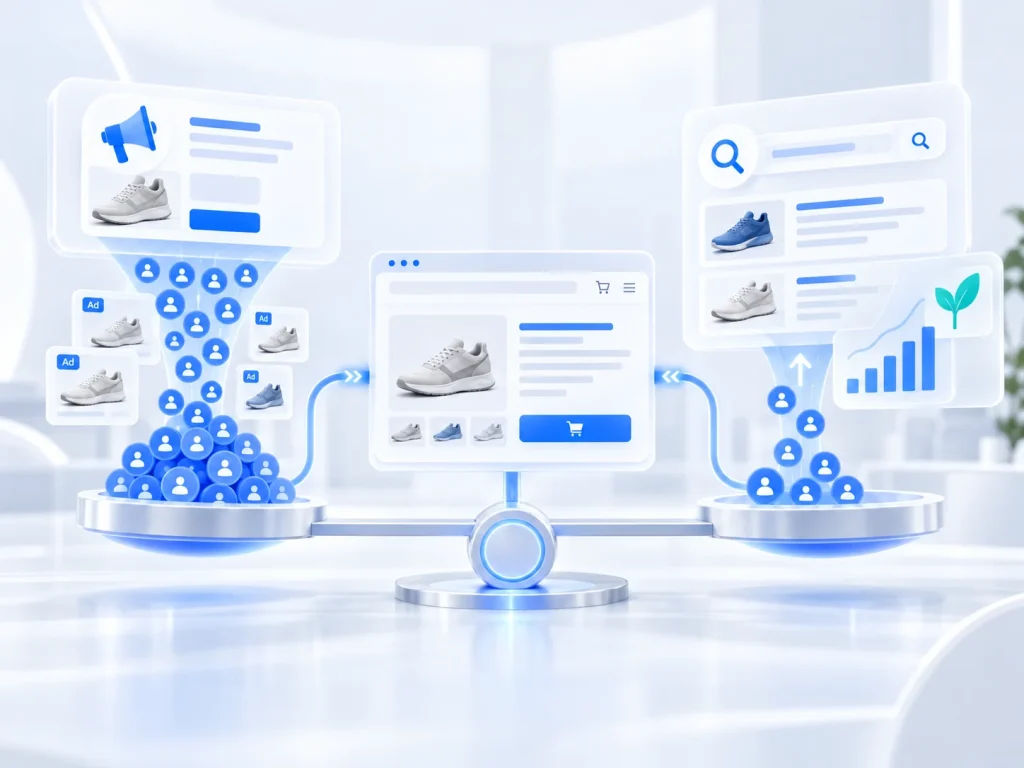
Meta Ads vs Google Ads for Shopify Brands: Where Each One Actually Earns Its Budget

The expensive mistake is not choosing Meta over Google. It is paying one channel to do the other channel’s job.

A Shopify brand can waste money on Meta trying to capture demand that already exists, or pour budget into Google when hardly anyone is searching for the product yet. Both platforms can produce strong ROAS. Both can also look better in the dashboard than they really are.

The question is not which platform deserves more budget by default. It is what your next advertising dollar actually needs to accomplish.

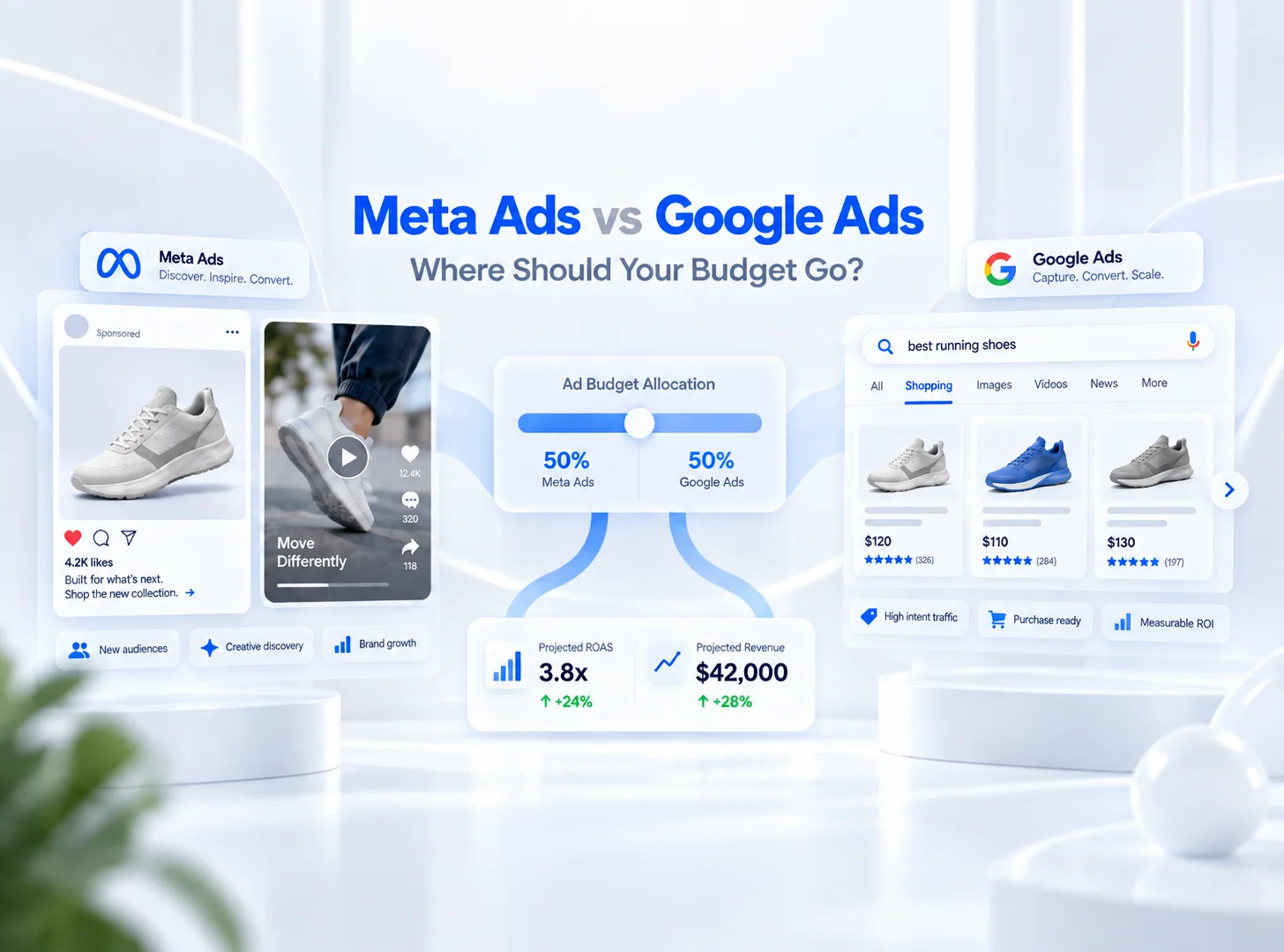
In this blog, we’ll look at where Meta and Google earn their place, why ROAS alone can mislead you, and how to build an ecommerce ad channel mix around what your store needs.

The real question is not Meta vs Google
Meta and Google Aren’t Competing for the Same Moment

“Meta creates demand. Google captures it.” Useful shorthand, but not the whole story.

Google Performance Max can run across Search, YouTube, Display, Discover, Gmail, and Maps, so Google is not limited to shoppers typing a query. Meta can also take someone from first exposure to retargeting and conversion.

The better way to think about paid social vs paid search is simple: what buying moment are you paying for?

Some products need attention before intent exists
Meta Earns Its Budget When People Aren’t Searching Yet

Some products already have people searching for them. Others need a little introduction before customers even realize they need them.

That is where Shopify Meta Ads can be useful.

A strong demo, creator-style video, unique use case, or simple visual hook can show the problem and solution in a single scroll. This is especially helpful for newer brands, unfamiliar products, or categories where customers need to see the value before they start searching for it.

But Meta still needs something that makes people stop. Better targeting and automation can help your ads reach the right audience, but they cannot turn a repetitive creative into something people want to watch. The product, the story, and the way you present it still matter.

Some products win when demand already exists
Google Earns Its Budget When the Shopper Is Already Looking

Google becomes especially valuable when shoppers are already telling you what they want.

Someone searching for “women’s waterproof hiking boots size 8” is giving you a different signal from someone scrolling Instagram.

Shopping ads can show a product photo, title, price, store name, and other product information before the click. Google also relies on Merchant Center data, such as price and availability, making feed quality a key part of performance.

For brands running Google Shopping ads, ecommerce performance depends on more than bidding. Product data, pricing, imagery, landing pages, and competition all affect whether that intent turns into profitable traffic.

Intent helps. It does not guarantee profitability.

Attribution does not always reveal contribution
The Better ROAS Number Can Still Send You the Wrong Signal

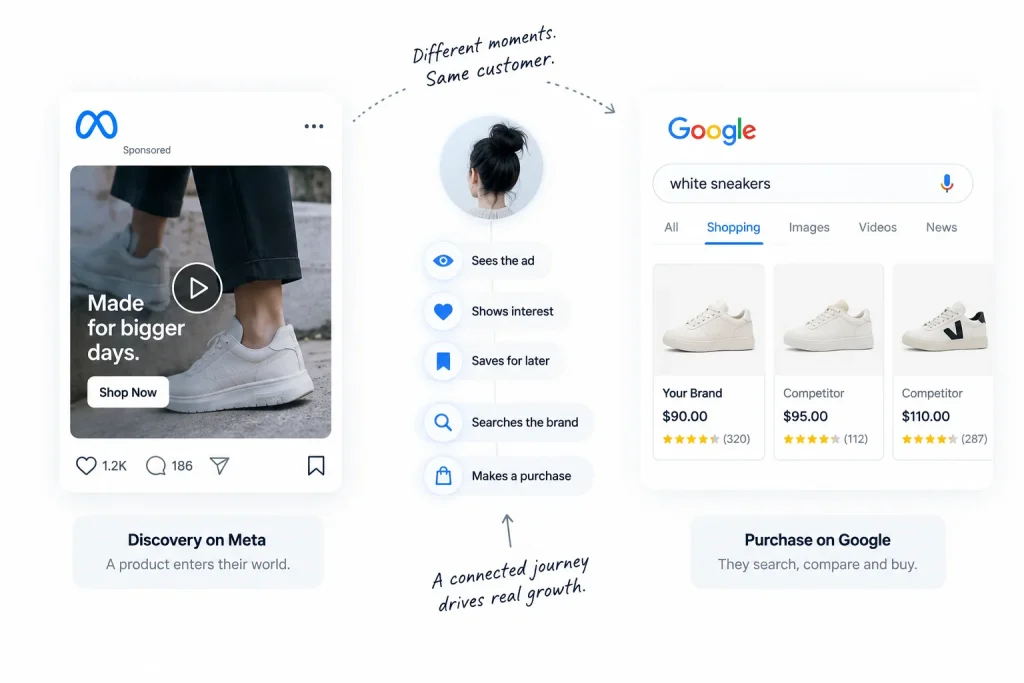
StoreHQ visual showing a shopper discovering a product on Meta, then searching and purchasing through Google.

Imagine a Shopify brand sells a $90 product that looks great in a 15-second demo but has almost no category search volume.

Meta introduces it. People watch, click, save it, and move on.

A few weeks later, branded searches start climbing. Some of those shoppers search the product on Google, compare options, and buy.

Google may show the stronger ROAS. Did Google suddenly become the better channel?

Maybe. Or Meta helped create demand that Google later captured.

That is why attribution and contribution are not the same thing. Platform ROAS shows how a platform credits conversions. It does not automatically tell you where the next dollar will create the most incremental revenue.

You can see how that plays out in practice in this paid acquisition case study, where Meta, Google, creative testing, and funnel optimization all had to work together.

Profitability decides where spend belongs
Before You Move Budget, Look at the Economics

A channel deserves more spend only if the economics support it.

Margins determine how much acquisition cost you can absorb. AOV affects how quickly the first purchase pays back. Repeat purchase rate and LTV change how much you can reasonably spend to acquire a customer.

Then look at the product.

  • Is there meaningful search demand? 
  • Can it stop someone mid-scroll? Is the price competitive in Shopping? 
  • Do you have enough creative to keep Meta fresh? 
  • Is the feed strong enough for Google to understand what you sell?

Those answers matter more than somebody else’s “ideal” Meta-to-Google split.

Your strategy should follow the actual constraint
Stop Splitting the Budget 50/50 by Default

Start with the problem, not the percentage.

Low search demand but strong creativity? Meta probably has more demand-generation work to do.

Strong commercial search demand? Google Search and Shopping may have more room, provided your margins, feed, and conversion rate support the cost.

Both channels working? Do not scale them equally just because both are profitable. Watch where additional spend starts to become less efficient and where the next dollar still has room to grow.

Neither working? Moving budget may not fix anything. The real bottleneck could be the offer, creative, pricing, product page, tracking, or checkout experience. If you are not sure where the problem sits, start by identifying whether your store has a traffic, conversion, or retention problem.

Your ecommerce ad channel mix should follow the bottleneck, not a preset ratio.

Understanding the role of each channel
Frequently Asked Questions

Are Meta Ads or Google Ads better for Shopify stores?

Neither is universally better; the right channel depends on demand, product economics, creative strength, and the job your budget needs to do.

Should a new Shopify brand start with Meta or Google Ads?

Start where the strongest opportunity exists: Meta when demand needs to be created, or Google when meaningful purchase-intent search demand already exists.

Are Google Shopping ads better than Meta Ads for ecommerce?

Google Shopping can capture existing product intent, while Meta can create interest before the shopper starts searching.

How should ecommerce brands split Meta and Google ad budgets?

Base the split on marginal efficiency, profitability, available demand, creative capacity, and each channel’s role in the buying journey rather than a fixed percentage.

The right channel mix starts with the right diagnosis
The Budget Should Follow the Bottleneck

Meta and Google are not competing to do exactly the same job. One Shopify brand may need more demand creation. Another may already have demand and need to capture it more efficiently. Many growing brands eventually use some combination of both.

The important part is knowing what you are paying each channel to solve. Get a growth audit with StoreHQ to see where your acquisition budget is creating growth and where it may be working harder than it needs to.

What Agentic Commerce Means for Shopify Brands (and How to Get Ready)

Your next customer could decide to buy from you without ever browsing your store.

Shopify brands have spent years optimizing the path from an ad or search result to the product page and then to checkout. But AI shopping agents are starting to sit in the middle. They can narrow down products, compare options, check key details, and move a shopper toward purchase before your homepage has a chance to sell anything.

That changes what “conversion-ready” actually means.

In this blog, we’ll look at what agentic commerce changes and what getting agent-ready actually involves.

The buying journey is moving beyond the storefront
What Is Agentic Commerce and How Does It Work for Shopify Brands?

AI search can tell a shopper what to consider. Agentic commerce can help move that shopper toward a transaction.

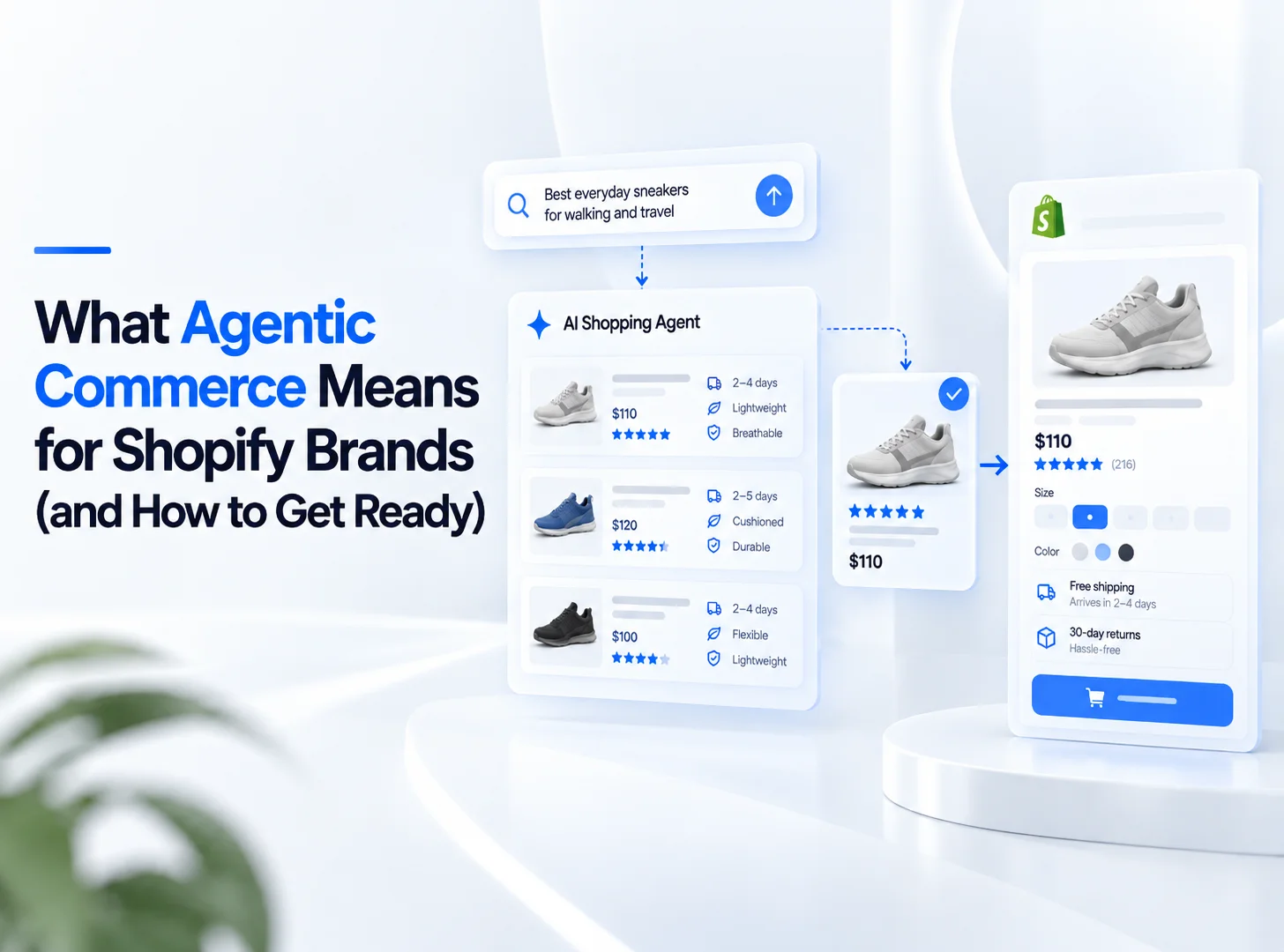
Instead of simply answering, “What are the best running shoes under $150?”, an AI agent can compare products, consider preferences, check current information, and guide the shopper toward checkout.

Shopify describes agentic commerce as a model where AI agents help shoppers discover, compare, and purchase products through conversational experiences. The exact journey varies by platform, but the AI can now become part of the buying path rather than just another place where your brand appears.

AI agents are becoming part of the decision process
AI Shopping Agents Can Influence the Buying Decision Before Your Store

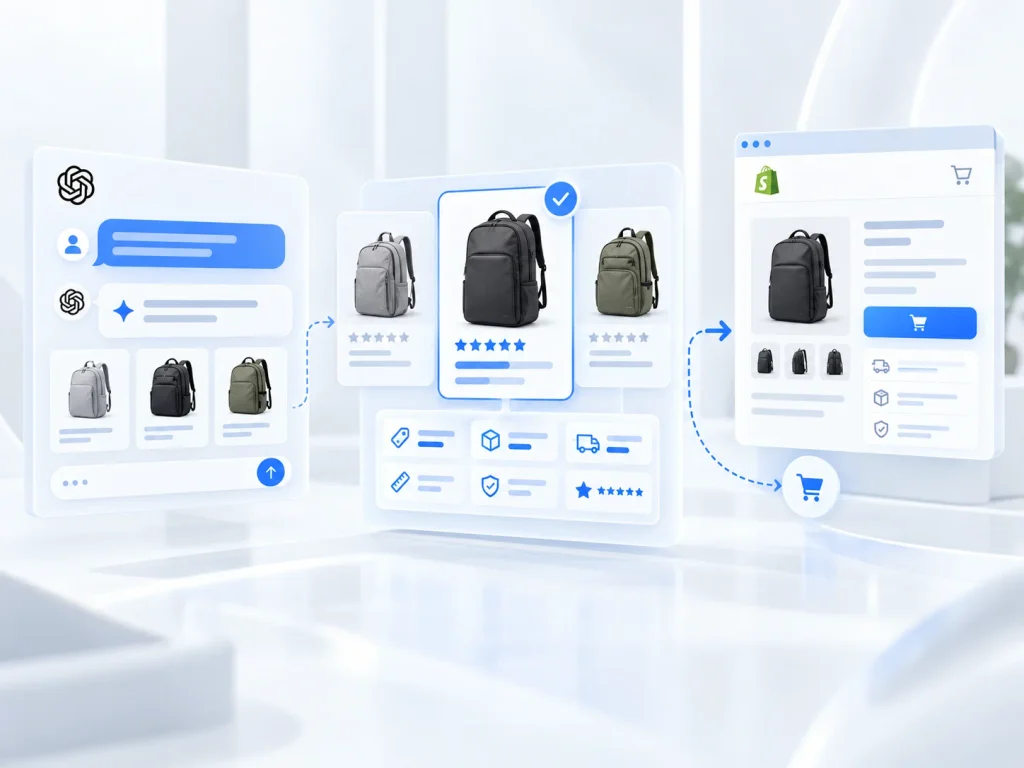
StoreHQ visual showing an AI shopping agent comparing backpacks and guiding a shopper from product selection to Shopify checkout.

Imagine someone asks an AI agent:

“I need a waterproof commuter backpack under $150 that fits a 16-inch laptop and can arrive by Friday.”

Your brand may sell the perfect option. But can the agent tell?

It needs reliable information on price, size, materials, availability, use case, and shipping to determine whether your product is a fit.

Your website still matters, but it may no longer get the first opportunity to persuade the shopper. An AI shopping agent can narrow the consideration set before the shopper reaches you.

Getting your products discovered by AI is only the first step. The next is making sure those systems can actually understand what you sell.

Your product data is becoming your digital shelf
Product Data Is Becoming Your New Storefront

In traditional e-commerce, merchandising is mostly visual. You control the photos, the product copy, reviews, FAQs, and page layout.

An AI agent works with the information it can access and understand.

Shopify Catalog organizes product data so AI can find it more easily, while connected sales channels and feeds help support other agent-based experiences. Shopify says merchants do not need to rebuild their catalog for agentic commerce, although custom data setups can use Catalog Mapping to fine-tune how products are represented.

But completeness matters. If a product description is vague, important details are missing, or variants are not clearly defined, an AI agent has less context to know when your product matches a shopper’s request.

Your product page is still selling to people. The information behind it also needs to be machine-readable.

Conversion now starts before the cart
How AI Agent Checkout Changes Ecommerce Conversion

Once an agent has helped a shopper choose a product, the next question is whether the purchase can keep moving. Price, availability, shipping, and payment options must match what the shopper has already been shown.

If they do not, friction starts before the customer even reaches the cart.

Shopify’s current setup already reflects this. ChatGPT primarily serves as a discovery and referral channel, while supported experiences such as Google AI Mode, Gemini, Microsoft Copilot, and Meta can offer Shopify-powered checkout where available.

AI agent checkout is not just another checkout button. It depends on the systems behind your store staying accurate and in sync.

Preparation starts with a stronger commerce foundation
Is Your Shopify Store Actually Agent-Ready?

You probably do not need an “AI transformation project.” You need a cleaner commerce foundation, starting with a broader ecommerce growth audit of the systems already supporting discovery, conversion, and measurement.

Start by checking the parts of your store an AI agent actually depends on.

  • Review product completeness: Check whether important titles, descriptions, attributes, variants, and use-case details are missing or inconsistent.
  • Check channel access: Confirm which agentic storefronts are active in Shopify and whether the products you want surfaced are eligible.
  • Test transaction readiness: Make sure pricing, inventory, shipping, payment, and policy information stays consistent throughout the buying journey.
  • Review how products appear: Use Shopify’s Agentic tools to preview catalog visibility and identify products that may be poorly represented.
  • Confirm measurement: Check whether AI-driven sessions, referrals, and orders are clearly attributed.

Shopify lets eligible merchants manage AI channel access through the Agentic area of the admin.

Once the setup is in place, the next job is proving whether it is actually driving business.

Visibility alone is no longer enough
Don’t Measure This Like Another SEO Channel

If AI becomes part of the purchase journey, visibility alone is not enough.

You need to know which AI channels are sending shoppers, which products are being surfaced, where orders originate, and whether that traffic converts.

Shopify attributes orders from AI channels by channel or referrer in the admin, allowing brands to separate AI-assisted commerce from the rest of their traffic.

That makes agentic commerce a performance question, not just a visibility question.

Common questions about the next ecommerce shift
Frequently Asked Questions

What is agentic commerce?

Agentic commerce is a shopping model where AI agents help consumers discover, compare, and move toward purchasing products through conversational experiences.

How is agentic commerce different from AI search?

AI search mainly helps users find and evaluate information, while agentic commerce can carry more of the journey from discovery to transaction.

Does Shopify support AI agent checkout?

Yes, Shopify supports agentic storefronts and direct checkout on certain AI channels, although availability and checkout behavior vary by platform and market.

How can Shopify brands prepare for agentic commerce?

Start with accurate product data, reliable commerce information, the right agentic channel settings, and clear AI traffic and order attribution.

The future of commerce depends on readiness
Agentic Readiness Is a Commerce Problem, Not an AI Project

Agentic commerce does not create a completely new growth system. It changes where your existing one needs to work. Your product discovery, merchandising, conversion, and tracking all need to perform well, even when an AI agent helps shape the buying decision before the shopper reaches your store.

The goal is not to chase every new AI feature. It is to make sure your store can perform wherever the buying journey starts next. Get a growth audit with StoreHQ to uncover the gaps that could be limiting discovery, conversion, and agentic readiness.

What E-Commerce Marketers Need To Know About AI Discoverability

Shoppers aren’t starting their product searches the way they used to. Instead of typing keywords into Google and scanning the results, more people are turning to ChatGPT, Perplexity, Gemini, and Google’s AI-powered search experiences to research what to buy. That shift is quiet, fast, and already affecting e-commerce brands that haven’t changed a single thing about their marketing.

In this blog, we cover what AI discoverability means for e-commerce marketers, how AI systems decide which products to surface, and what brands can do to improve visibility across structured data, content, reviews, and product discovery channels. 

The search journey is moving beyond Google
AI Discovery Is Changing Where Shoppers Start Their Journey

ChatGPT, Perplexity, and Google AI Overviews have become real product discovery touchpoints. A shopper looking for the best running shoes for flat feet or a lightweight stroller within a certain price range asks AI directly and gets a recommendation without ever visiting the search results page. That recommendation may or may not include your brand.

The traditional keyword-driven search funnel assumed shoppers would click, compare, and browse product pages. AI search compresses that process. Shoppers get curated answers based on what AI systems trust, and brands that haven’t optimized for that environment are losing e-commerce AI visibility without having done anything wrong by old standards.

Why some products get recommended and others disappear
How AI Systems Actually Decide What to Show

AI shopping experiences don’t simply reproduce traditional search rankings. Depending on the platform, they can draw from product data, structured metadata, web content, reviews, merchant feeds, and other sources to determine which products are relevant to a shopper’s request.

Social proof carries real weight here. Reviews can influence how products are evaluated in AI-powered shopping experiences, while third-party mentions give systems additional context beyond what a brand says about itself. Context and shopper intent also matter. An AI answering a specific question looks for content that addresses the use case directly, not content that simply contains the right words.

Ranking is no longer the only way to get discovered
Why Traditional SEO Isn’t Enough Anymore

Ranking on page one of Google and appearing in an AI-generated answer require different inputs. Traditional SEO focuses on backlinks, keyword placement, and crawlability. AI SEO depends more on structured data quality, semantic clarity, and authority signals that extend well beyond your own site.

Zero-click discovery adds complexity. When a shopper gets what they need from an AI-generated result without clicking through, there is no website session for your analytics platform to attribute, even though your brand may still have influenced the decision. You may be influencing purchase decisions with no measurable traffic to show for it. Most e-commerce marketing strategies aren’t built to handle that attribution blind spot.

The dark funnel, where shoppers research using AI before arriving at your site through direct traffic or a branded search, is growing. Brands that don’t account for it will consistently undervalue top-of-funnel efforts and misread which channels are actually driving conversions.

The signals that influence AI recommendations
What E-Commerce Brands Need to Optimize for AI Visibility

AI visibility depends on more than showing up in search. E-commerce brands need to make their product information easy to read, easy to verify, and easy to match with real shopper intent. That means cleaning up structured data, strengthening product feeds, answering buyer questions directly, and building enough trust signals off-site for AI systems to recognize the brand as credible. 

Structured Data and Product Feed Quality

Schema markup for products, reviews, and pricing gives AI systems the structured signals they need to represent your brand accurately. Without it, AI models interpret your pages on their own, and gaps in that interpretation lead to misrepresentation or omission. Clean, complete product feeds across your site, Google Merchant Center, and third-party channels reduce the likelihood that your products will be passed over.

Data gaps are where AI discoverability breaks down most often. Missing attributes, outdated pricing, or inconsistent product names across feeds give AI systems reason to deprioritize your listings in favor of brands with cleaner data.

Content That Answers Real Shopper Questions

Intent-driven content is better suited to the natural-language questions shoppers ask AI tools than copy written around exact-match keywords alone. Product descriptions and category pages that explain use cases, solve specific problems, and address common questions give AI systems more to work with when matching your products to shopper intent.

FAQ-style content mirrors how shoppers phrase questions to AI assistants. A shopper asking “what’s the best moisturizer for dry skin in winter” isn’t typing a keyword. Building content that reflects that natural question structure gives your brand a better shot at appearing in the generated answer.

Brand Authority and Social Proof

Review volume and recency are AI trust signals. A brand with hundreds of recent, detailed reviews reads as more credible to an AI system than one with a handful of older ratings. Mentions across editorial content, forums, and third-party sites further reinforce that authority.

Consistent brand information across all channels also matters. When your brand name, product names, and key details appear the same way everywhere, AI systems can connect those signals more reliably and represent your brand accurately in generated outputs.

Visibility needs a new way to be measured
How to Start Measuring AI-Driven Visibility

Tracking AI discoverability means looking beyond standard analytics. Start by monitoring brand mentions and product appearances in AI-generated outputs, either manually or through tools built for this purpose. Check whether your brand appears in responses from ChatGPT or Perplexity for relevant product queries.

Dark funnel signals are worth watching closely. Spikes in direct traffic, increases in branded search volume, and growth in assisted conversions can all indicate that AI-assisted discovery is happening before your measurable touchpoints. StoreHQ helps brands connect these signals across search, reviews, product data, and conversion paths, making AI visibility easier to track and act on. Adjusting your attribution models to account for that pre-visit research gives you a more accurate picture of what’s actually driving revenue in AI search ecommerce conditions. 

Book a demo to see where your biggest growth opportunities lie.

Common questions about the next search shift
Frequently Asked Questions

What is AI discoverability in e-commerce?

It refers to whether your products appear in AI-generated answers and recommendations across tools like ChatGPT, Perplexity, and Google AI Overviews when shoppers ask product-related questions.

Is AI SEO different from traditional SEO?

Yes. AI systems prioritize structured data, semantic relevance, and authority signals over keyword density and backlink volume alone. The optimization inputs differ, even though some fundamentals overlap.

Do I need to change my entire e-commerce marketing strategy for AI search?

Not entirely. Strong fundamentals still apply, but layering in structured data, conversational content, and brand authority work is what keeps you visible in AI-driven discovery.

How do I know if AI is driving traffic or sales to my store?

Watch for increases in direct traffic, branded search volume, and assisted conversions. Use tools that track AI referral sources where available, and treat these signals as indicators of upstream AI influence.

AI visibility is becoming a growth channel
AI Discoverability Is Now Part of E-commerce Growth 

AI discoverability is already shaping how shoppers find products. Brands that treat it as a present-day priority are building an advantage over those still optimizing purely for traditional search. The starting points are clear: audit your structured data, sharpen your product content, and consistently build review volume.

Get a growth audit with StoreHQ to see how your e-commerce brand appears across AI search, product discovery, reviews, and structured data signals.

Google Search vs. AI Search: How People Discover Products in 2026

Product discovery no longer follows one search path. A shopper might type “best running shoes for flat feet” into Google, open a few product pages, and compare options. Another might ask ChatGPT, Gemini, or Perplexity to recommend three pairs and explain which one fits their needs best.

Google is also adding more AI-generated experiences to search. So this is not simply Google versus AI. It is a shift between two ways of discovering products: browsing a list of results or getting a direct, summarized answer.

For Shopify brands, the AI search vs Google Search shopping shift changes what visibility means. Ranking on Google still matters. But now your products also need to be easy for AI systems to understand, compare, and recommend.

Google still owns intent-driven shopping
Google Search Still Captures High-Intent Shopping Demand

Traditional Google Search remains powerful when shoppers already have a clear idea of what they want.

They search with specific keywords, compare organic results, browse Shopping listings, read reviews, and move between category and product pages before making a decision.

That means the fundamentals of ecommerce SEO still matter: crawlable pages, useful product descriptions, strong collection pages, internal linking, structured data, fast load times, and content built around high-intent searches.

A proper ecommerce growth audit should still review these areas because weak technical SEO or poorly optimized commercial pages can reduce visibility before shoppers even reach your store.

AI is changing how shoppers compare products
AI Search Shortens the Comparison Process

AI shopping discovery works differently.

Instead of searching “best carry-on luggage,” a shopper might ask, “What is the best lightweight carry-on under $250 for frequent international travel?”

They can then ask follow-up questions about size, durability, features, or alternatives without starting another search. AI tools can gather information, compare products, and narrow the options before a shopper reaches a brand’s website.

This is how AI search is changing ecommerce. If your store ranks well but your product information is unclear or incomplete, you may still miss this part of the shopping journey.

The future is not SEO vs AEO
AEO vs SEO: What Actually Changes?

The AEO vs SEO conversation can make it sound like brands need to choose one strategy over the other.

They do not.

SEO helps search engines crawl, understand, index, and rank your pages. Answer engine optimization builds on that foundation by making your information easier for AI systems to understand, verify, and include in answers.

The basics have not disappeared. The way shoppers receive information is changing.

That means optimizing for AI search engines should support your existing SEO strategy rather than replace it.

SEO still focuses on search intent, technical health, internal links, authority, page relevance, and rankings. AEO puts more emphasis on clear product details, structured data, direct answers, useful comparison information, reviews, consistent brand details, and credible off-site sources.

For Shopify brands, the strongest approach is to build for both.

The signals that help products get recommended
What Shopify Brands Should Optimize Now

Creating one completely separate strategy for Google and another for AI can create more work without fixing the real problem.

  • Protect your SEO foundation- Keep product and collection pages fast, crawlable, internally linked, and aligned with buyer intent.
  • Improve product data- Keep titles, specifications, categories, pricing, availability, and product feeds clear and consistent.
  • Add structured context- Product, Offer, and Review schema can help machines understand important product information.
  • Answer buying questions- Explain who the product is for, what it helps with, and how it compares with other options.
  • Build trust beyond your site- Reviews, retailer listings, editorial mentions, and consistent third-party information can strengthen credibility.

These changes can support conversion as well. Clearer product information is easier for AI systems to interpret and easier for shoppers to trust.

Visibility now has more than one metric
Measure Both Types of Visibility

Google rankings and organic clicks still matter, but they no longer show the full picture.

Brands should also look at whether their products appear in AI-generated answers, which competitors are being recommended, what questions shoppers are asking, and which websites AI tools repeatedly reference.

If AI visibility is weak, review your product data, schema, buyer-focused content, reviews, and off-site authority. 

Our guide on making products discoverable in AI answers explores these signals in more detail.

The questions brands need answered
Frequently Asked Questions

Is AI search replacing Google Search for ecommerce?

No, AI search is adding another product discovery path while Google remains important for high-intent searches and direct shopping activity.

What is the difference between AEO and SEO?

SEO focuses on helping pages rank in search results, while AEO helps information become easier for AI systems to understand and use in generated answers.

How is AI search changing ecommerce product discovery?

AI search lets shoppers compare products, ask follow-up questions, and narrow their choices before visiting individual ecommerce websites.

Should Shopify brands optimize for AI search engines now?

Yes, Shopify brands should start improving product data, structured content, reviews, and authority while continuing to invest in traditional SEO.

Can the same content support both Google Search and AI search?

Yes, clear product information, useful buyer-focused content, structured data, and strong trust signals can improve visibility across both search experiences.

Winning visibility across the modern buyer journey
Search Visibility Now Has Two Jobs

Google Search and AI search are not replacing each other. They are giving shoppers two different ways to move from a question to a shortlist.

SEO helps your Shopify store compete when shoppers search, browse, and click. AEO helps your products become easier to understand and recommend when AI systems compare options.

Book a growth audit to understand where your store is visible and where AI systems may be missing your products.