Shoppers are no longer just typing keywords into Google. They’re asking ChatGPT which protein powder to buy, asking Perplexity which running shoes fit wide feet, and asking Gemini to suggest a skincare routine under $100. These AI tools pull answers from structured, authoritative product content, not from whoever holds the top ranking. For ecommerce brands, visibility now depends on how well your product data is organized, how much trust your brand has built off-site, and whether AI models can read your content with enough confidence to cite it.
In this blog, we’ll explain how ecommerce brands can make their products more discoverable in AI answers by improving product data, agentic title and description, schema markup, reviews, off-site trust signals, and buyer-focused content.
Why AI Search Is Changing How Products Get Found
Traditional search asks shoppers to choose between links. AI search often makes recommendations for them. When someone asks “what’s the best blender for smoothies under $150,” they want a name, a reason, and a source worth trusting. AI models look at products that frequently appear in reliable, well-structured content across the web. Brands absent from those answers lose purchase intent at the exact moment it peaks, and that revenue risk compounds as AI search adoption grows.
AI search also changes what it means to be visible online. Ranking on the first page is no longer enough if AI platforms aren’t mentioning your brand in their responses. Visibility now depends on how well your products, content, reviews, and brand signals are understood and trusted across the web. Brands that consistently appear in AI-generated recommendations gain exposure much earlier in the buying journey, while those that don’t risk becoming invisible even if they rank well in traditional search results.
How AI Models Actually Decide What to Recommend
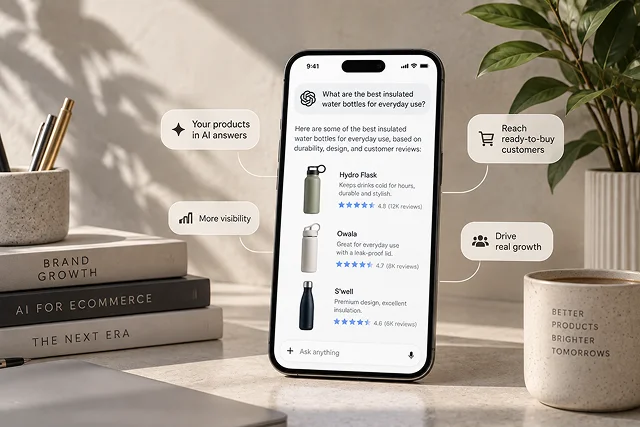
AI models don’t recommend products based solely on keywords. They evaluate how well a product aligns with user intent by analyzing product content, reviews, brand mentions, third-party references, and other trust signals across the web. As AI-powered search becomes more agentic, models are increasingly expected to compare options, evaluate fit, and recommend products on behalf of users rather than simply retrieve information. This makes agentic titles and descriptions increasingly important, as they help AI systems quickly understand a product’s purpose, target audience, key benefits, and ideal use cases.
The difference between feature-focused content and use-case-focused content matters here. A product page that only lists specifications gives AI limited context, while one that explains who the product is for, what problems it solves, and when it should be used provides stronger signals for recommendation.
Structure Your Product Data So AI Can Read It
Product pages built for AI discoverability need complete, accurate attributes: clear titles, descriptive categories, and copy written around buyer use cases rather than spec lists. Schema markup for products, reviews, and FAQs signals to AI models what each page contains and how it connects to buyer queries. FAQ sections on product and category pages carry particular value because they mirror the conversational format AI answers are built from. If your product page answers “who is this for,” “what problem does it solve,” and “how does it compare to alternatives,” you’re giving AI models the structured signals they need to surface your product in relevant answers.
Build the Off-Site Signals AI Models Trust
Your product page alone is rarely enough to earn visibility in AI-generated recommendations. AI models look beyond your website to evaluate whether a product is credible, trusted, and widely recognized. Product reviews across retailer websites, marketplaces, and Google Shopping help validate customer satisfaction, while mentions in buying guides, comparison articles, press coverage, and editorial roundups strengthen authority signals. Consistency matters as well. When product names, descriptions, specifications, and positioning align across channels, AI systems can understand and trust the information more confidently. Brands with strong third-party validation and consistent product data are far more likely to be surfaced in AI-generated answers than those relying solely on their own website content.
Content Formats That Get Pulled Into AI Answers
AI models favor content that answers questions directly in a clean, structured format. Q&A sections on product pages, comparison content framed with “best for” language, and concise answers to common buyer questions all match the format AI uses to build its responses. A product page with a section answering “Is this suitable for sensitive skin?” or “How does this differ from the standard model?” is far more likely to be cited in an AI answer than a page that only describes the product in unbroken paragraphs. Writing for AI discoverability and writing for human buyers point in the same direction.
Where Most Ecommerce Brands Fall Short
The most common gaps include thin product descriptions that fail to differentiate the product, incomplete schema markup, and limited visibility across third-party sources that AI models frequently reference. Platforms such as Reddit, product review sites, retailer reviews, buying guides, comparison articles, industry publications, and editorial roundups often play an important role in shaping how AI systems evaluate products and brands. AI models don’t rely solely on what a brand says about itself, they look for supporting signals across the broader web to determine credibility, relevance, and trustworthiness.
Consistency matters as well. Product names, descriptions, specifications, and positioning should align across your website, marketplaces, retailer listings, and other external sources. Conflicting information can reduce confidence and make it harder for AI systems to accurately understand and recommend a product. Without strong third-party validation and a consistent digital footprint, even products that perform well in traditional search can struggle to gain visibility in AI-generated recommendations.
Frequently Asked Questions
Does AI search replace Google for product discovery?
Not entirely, but it’s becoming a meaningful channel as many shoppers use AI tools alongside traditional search, and some go straight to AI for recommendations, especially for higher-consideration purchases.
What schema markup matters most for product pages?
Product schema, Review schema, and FAQ schema are the most relevant. They help AI models identify what a page is about, what buyers think of it, and what questions it answers.
How do reviews affect AI product recommendations?
Reviews act as third-party validation. AI models treat high-volume, consistent reviews across platforms as a trust signal, making those products more likely to appear in recommendations.
Can smaller ecommerce brands compete in AI search?
Yes. AI models prioritize relevance and structure, not brand size. A smaller brand with well-structured product data, strong reviews, and specific use-case content can outperform larger brands running generic pages.
Build Product Visibility with StoreHQ
AI discoverability builds over time. Brands that structure their product data, invest in reviews, and build off-site authority now create an edge that gets harder for competitors to close. The practical starting point is a straightforward audit: how complete is your product data, how much schema coverage do you actually have, and where does your brand appear when AI tools look for third-party validation.
Get a growth audit with StoreHQ, and improve your product data, schema coverage, reviews, and AI discoverability signals.

 6 min read