How to Measure Whether Your Brand Actually Shows Up in AI Answers

Your competitors might be showing up in ChatGPT answers while your brand gets left out.

A shopper asks for the best products in your category. AI recommends three brands. Yours is not one of them.

Google rankings won’t show you that. AI visibility tracking can.

In this article, we will look at how to check where your brand appears, compare it with competitors, and measure whether that visibility is improving.

Search rankings only show part of the visibility picture
Your Google Rankings Won’t Tell You This

Ranking on Google and appearing in an AI answer are not the same thing.

Traditional Google search gives shoppers a list of results. AI tools may answer directly, mention brands, compare products, or cite sources.

That gives you two signals to watch: brand mentions and website citations.

Your store could rank well for a product keyword and still be missing from an AI shortlist. It could also be cited as a source without your brand being named clearly.

That is why AI visibility needs to be tracked separately from normal SEO rankings.

Test the questions your customers actually ask
What Does AI Say When Shoppers Ask About Your Products?

Start with the questions a new customer would actually ask.

If you sell skincare, don’t just search for your brand name. Test questions like:

  • What is the best moisturizer for dry skin?
  • Which skincare brands are good for sensitive skin?
  • What should I look for in a vitamin C serum?
  • Which moisturizers are under $50?

Run the same questions across ChatGPT, Gemini, and Perplexity. Record which brands appear and which websites are cited.

AI answers can change from one run to the next. Repeated patterns across the same questions tell you much more.

A few signals can reveal where your brand stands
Four Signals That Show How Visible Your Brand Really Is

You do not need a dashboard full of numbers.

Say a skincare brand tracks 20 buyer questions. It appears in 6 answers. Its website gets cited in 3. Your main competitor appears in 12. Two answers contain outdated product information.

That gives you four useful signals:

  • Brand mentions show how often your business appears.
  • Website citations show how often AI tools reference your own pages.
  • Share of voice in AI search compares your visibility with competing brands.
  • Brand accuracy shows whether AI is describing your products correctly.

Using a simple mentions-based calculation, if your brand earns 6 mentions and competitors collectively earn 18, your share of voice is 25%.

Different platforms may calculate AI share of voice differently, so always check what the score actually represents.

The goal is not to chase one perfect score. It is to see where you appear, where you do not, and whether that pattern changes.

Your competitors can show you where the gaps are
Are Your Competitors Getting Recommended Instead?

Look at the questions where your brand is missing but the same competitors keep showing up.

Why are they being recommended? Better reviews? Clearer product benefits? Stronger buying guides? More third-party coverage?

If competitors keep appearing for “best moisturizer for sensitive skin,” check whether your own product pages clearly explain ingredients, skin type, texture, use, and who the product is for.

These AI-shopping-ready product page checks can help you spot information gaps that make products harder for shoppers and AI tools to understand.

The goal is to understand why they’re part of the answer when you’re not.

Visibility matters more when you can track the trend
Is Your AI Visibility Actually Improving?

Keep the same prompt list and platforms. Record the date, brand mentions, citations, competitor mentions, and any inaccurate details. Then repeat the check monthly.

Over time, this gives you a simple GEO reporting view you can compare month to month.

As the prompt list grows, an AI visibility tool can make tracking easier.

But AI search rank tracking is not the same as tracking position 1, 2, or 3 on Google. AI answers can vary, and different tools may use different prompts and scoring methods.

Focus on trends instead.

Are you appearing in more relevant answers? Are citations increasing? Are competitors showing up less often for questions that matter to your category?

Start with the places where your brand disappears
Not Showing Up? Here’s What to Check First

Start with the prompts where your brand is missing.

Do your product pages answer those buyer questions clearly? Are product details easy to find? Do you have useful comparisons, FAQs, buying guides, reviews, and accurate structured product information?

Then look beyond your site. Reviews, editorial mentions, and other credible third-party sources can also shape what AI systems find and reference.

If you are unsure where the gaps are, a broader ecommerce growth audit can help you review technical SEO, product content, conversion issues, and AI discoverability together.

Also keep referral traffic separate from visibility.

GA4 can track visits from AI assistants such as ChatGPT and Gemini, but it cannot tell you every time your brand appeared in an AI answer without a click.

That is why traffic and AI visibility should be measured separately.

Common questions about measuring AI visibility
Frequently Asked Questions About AI Visibility Tracking

How can I track brand mentions in ChatGPT?

Use a consistent set of buyer questions and record when your brand appears. Repeat the same checks over time.

What is AI visibility tracking?

It measures how often your brand appears in AI answers, which pages get cited, and how your visibility compares with competitors.

Can I track AI search rankings like Google rankings?

Not exactly. Mentions, citations, share of voice, and trends are more useful than fixed positions.

What does share of voice mean in AI search?

It shows how much visibility your brand gets compared with competitors across a defined set of prompts.

How often should I check AI visibility?

Monthly is a practical starting point for most stores.

Know where you appear before deciding what to improve
Know Where Your Brand Stands in AI Search

You do not need hundreds of prompts to learn something useful. Start with the questions that matter to your customers, see which brands appear, and track the pattern over time.

If competitors keep showing up where your brand does not, you have something specific to investigate instead of guessing.

Get a free growth audit from StoreHQ to see where SEO, product content, and AI discoverability may be limiting your store’s visibility.
How to Make Your Products Discoverable in AI Answers

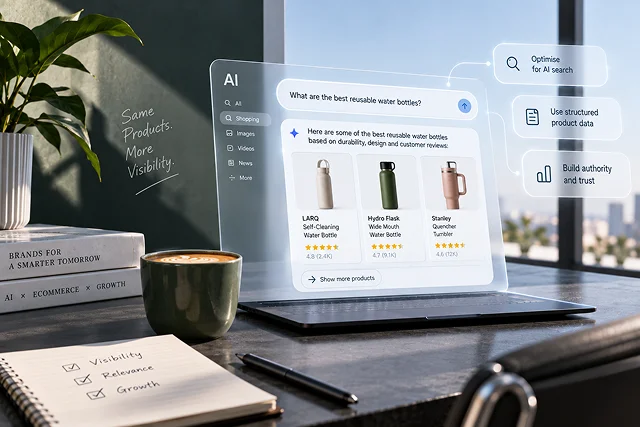
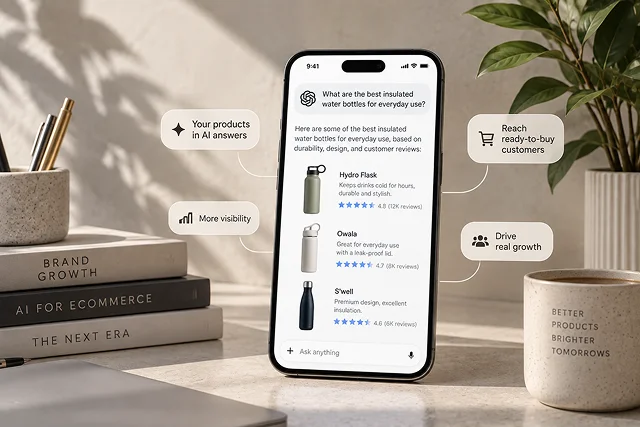
Shoppers are no longer just typing keywords into Google. They’re asking ChatGPT which protein powder to buy, asking Perplexity which running shoes fit wide feet, and asking Gemini to suggest a skincare routine under $100. These AI tools pull answers from structured, authoritative product content, not from whoever holds the top ranking. For ecommerce brands, visibility now depends on how well your product data is organized, how much trust your brand has built off-site, and whether AI models can read your content with enough confidence to cite it.

In this blog, we’ll explain how ecommerce brands can make their products more discoverable in AI answers by improving product data, agentic title and description, schema markup, reviews, off-site trust signals, and buyer-focused content. 

Product discovery is moving beyond traditional search
Why AI Search Is Changing How Products Get Found

Traditional search asks shoppers to choose between links. AI search often makes recommendations for them. When someone asks “what’s the best blender for smoothies under $150,” they want a name, a reason, and a source worth trusting. AI models look at products that frequently appear in reliable, well-structured content across the web. Brands absent from those answers lose purchase intent at the exact moment it peaks, and that revenue risk compounds as AI search adoption grows.

AI search also changes what it means to be visible online. Ranking on the first page is no longer enough if AI platforms aren’t mentioning your brand in their responses. Visibility now depends on how well your products, content, reviews, and brand signals are understood and trusted across the web. Brands that consistently appear in AI-generated recommendations gain exposure much earlier in the buying journey, while those that don’t risk becoming invisible even if they rank well in traditional search results.

AI recommendations depend on more than keywords
How AI Models Actually Decide What to Recommend

AI models don’t recommend products based solely on keywords. They evaluate how well a product aligns with user intent by analyzing product content, reviews, brand mentions, third-party references, and other trust signals across the web. As AI-powered search becomes more agentic, models are increasingly expected to compare options, evaluate fit, and recommend products on behalf of users rather than simply retrieve information. This makes agentic titles and descriptions increasingly important, as they help AI systems quickly understand a product’s purpose, target audience, key benefits, and ideal use cases.

The difference between feature-focused content and use-case-focused content matters here. A product page that only lists specifications gives AI limited context, while one that explains who the product is for, what problems it solves, and when it should be used provides stronger signals for recommendation. 

Make your product information easier for AI to understand
Structure Your Product Data So AI Can Read It

Product pages built for AI discoverability need complete, accurate attributes: clear titles, descriptive categories, and copy written around buyer use cases rather than spec lists. Schema markup for products, reviews, and FAQs signals to AI models what each page contains and how it connects to buyer queries. FAQ sections on product and category pages carry particular value because they mirror the conversational format AI answers are built from. If your product page answers “who is this for,” “what problem does it solve,” and “how does it compare to alternatives,” you’re giving AI models the structured signals they need to surface your product in relevant answers.

Trust signals extend beyond your own website
Build the Off-Site Signals AI Models Trust

Your product page alone is rarely enough to earn visibility in AI-generated recommendations. AI models look beyond your website to evaluate whether a product is credible, trusted, and widely recognized. Product reviews across retailer websites, marketplaces, and Google Shopping help validate customer satisfaction, while mentions in buying guides, comparison articles, press coverage, and editorial roundups strengthen authority signals. Consistency matters as well. When product names, descriptions, specifications, and positioning align across channels, AI systems can understand and trust the information more confidently. Brands with strong third-party validation and consistent product data are far more likely to be surfaced in AI-generated answers than those relying solely on their own website content.

Answer-focused content earns more visibility
Content Formats That Get Pulled Into AI Answers

AI models favor content that answers questions directly in a clean, structured format. Q&A sections on product pages, comparison content framed with “best for” language, and concise answers to common buyer questions all match the format AI uses to build its responses. A product page with a section answering “Is this suitable for sensitive skin?” or “How does this differ from the standard model?” is far more likely to be cited in an AI answer than a page that only describes the product in unbroken paragraphs. Writing for AI discoverability and writing for human buyers point in the same direction.

The gaps keeping products invisible
Where Most Ecommerce Brands Fall Short

The most common gaps include thin product descriptions that fail to differentiate the product, incomplete schema markup, and limited visibility across third-party sources that AI models frequently reference. Platforms such as Reddit, product review sites, retailer reviews, buying guides, comparison articles, industry publications, and editorial roundups often play an important role in shaping how AI systems evaluate products and brands. AI models don’t rely solely on what a brand says about itself, they look for supporting signals across the broader web to determine credibility, relevance, and trustworthiness.

Consistency matters as well. Product names, descriptions, specifications, and positioning should align across your website, marketplaces, retailer listings, and other external sources. Conflicting information can reduce confidence and make it harder for AI systems to accurately understand and recommend a product. Without strong third-party validation and a consistent digital footprint, even products that perform well in traditional search can struggle to gain visibility in AI-generated recommendations.

Common questions about AI product discovery
Frequently Asked Questions

Does AI search replace Google for product discovery?

Not entirely, but it’s becoming a meaningful channel as many shoppers use AI tools alongside traditional search, and some go straight to AI for recommendations, especially for higher-consideration purchases.

What schema markup matters most for product pages?

Product schema, Review schema, and FAQ schema are the most relevant. They help AI models identify what a page is about, what buyers think of it, and what questions it answers.

How do reviews affect AI product recommendations?

Reviews act as third-party validation. AI models treat high-volume, consistent reviews across platforms as a trust signal, making those products more likely to appear in recommendations.

Can smaller ecommerce brands compete in AI search?

Yes. AI models prioritize relevance and structure, not brand size. A smaller brand with well-structured product data, strong reviews, and specific use-case content can outperform larger brands running generic pages.

Build visibility before the buying decision happens
Build Product Visibility with StoreHQ

AI discoverability builds over time. Brands that structure their product data, invest in reviews, and build off-site authority now create an edge that gets harder for competitors to close. The practical starting point is a straightforward audit: how complete is your product data, how much schema coverage do you actually have, and where does your brand appear when AI tools look for third-party validation.

Get a growth audit with StoreHQ, and improve your product data, schema coverage, reviews, and AI discoverability signals.