Your Shopify store does not need a completely new strategy every time search gets a new acronym.
AEO, GEO, and LLMO all describe work connected to how people find information. They focus on different parts of that process, but many of the improvements behind them are the same.
That can make it difficult to know what your store actually needs. Should you focus on Google rankings, AI recommendations, or how ChatGPT describes your products?
The useful question is what is stopping customers from finding and understanding what you sell.
In this blog, we will look at AEO vs GEO vs LLMO, how each connects to SEO, and which improvements Shopify brands should prioritize.
What Is the Difference Between AEO, GEO, and LLMO?
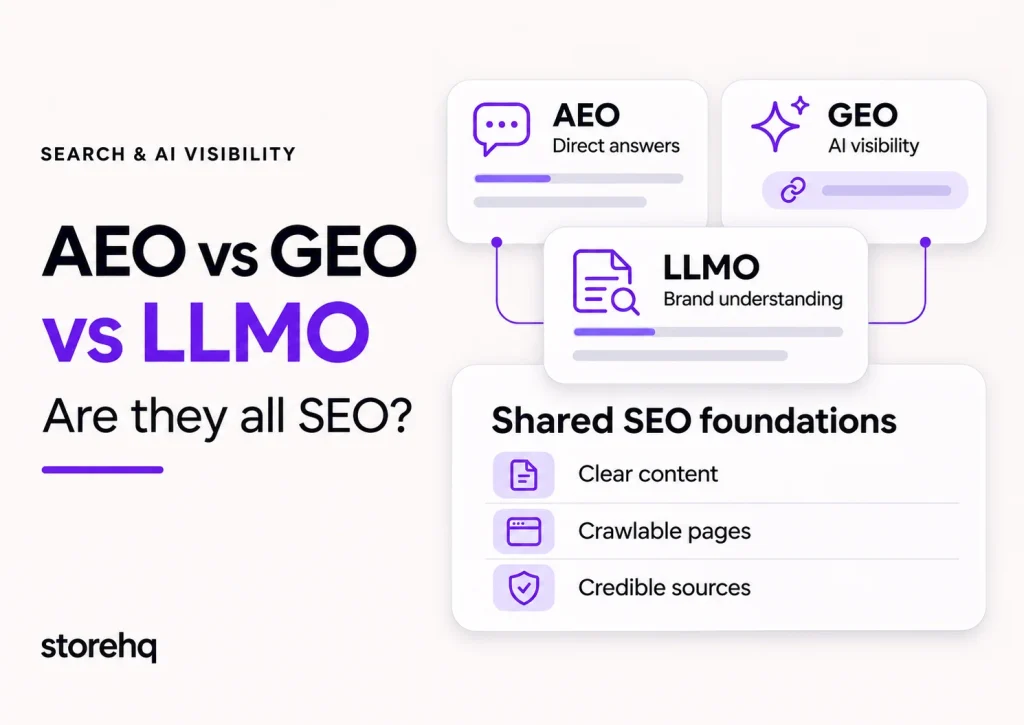
AEO, GEO, and LLMO focus on different ways your business appears in search and AI answers. SEO supports much of the work behind them.
| Approach | Main focus |
| AEO: Answer Engine Optimization | Making information useful for direct answers to specific questions. |
| GEO: Generative Engine Optimization | Helping your brand appear in AI-generated responses through mentions, recommendations, or citations. |
| LLMO: Large Language Model Optimization | Improving how language models understand and describe your business and products. |
| SEO: Search Engine Optimization | Helping search engines discover, understand, and rank relevant pages. It provides much of the shared foundation. |
These terms overlap, and definitions vary, especially for GEO and LLMO. One useful buying guide can support several goals, so you do not necessarily need separate content for each approach.
What Is Answer Engine Optimization?
Answer engine optimization, or AEO, helps your content answer a question clearly enough to be useful in a direct-answer experience.
The term is often linked to featured snippets and voice search. It is also used more broadly for answers delivered through conversational search tools.
For a Shopify store, this starts with questions people ask before buying.
Will this bag fit a 16-inch laptop? Can the cover go in the washing machine? What should someone choose if they are between sizes?
A useful product page answers those questions with the relevant details. It explains conditions or limitations when they matter.
For example, a laptop compartment measurement tells someone more than “designed for your everyday essentials.”
AEO is not simply adding an FAQ section. The answer needs to help the customer make a decision, wherever it appears on the page.
What Is Generative Engine Optimization?
Generative engine optimization, or GEO, focuses on how your brand appears in AI-generated answers.
That could mean a product recommendation, a brand mention, or a link to your website as a source. These outcomes can overlap, but they are worth measuring separately.
An assistant might cite your buying guide without recommending your products. It could also mention your brand without linking to your store.
Useful GEO work gives those systems better information to find and use. Clear specifications, practical comparisons, original testing, and relevant third-party coverage can all contribute to the information available.
For example, a backpack comparison becomes more useful when it explains capacity, laptop fit, weight, and weather protection using evidence.
Repeating that every option is “the best” gives shoppers little to compare.
The guide to making products discoverable in AI answers looks at the wider content and product information behind this process.
What Is Large Language Model Optimization?
Large language model optimization, or LLMO, describes work intended to improve how LLM-powered systems understand and describe your business.
It overlaps heavily with GEO. The emphasis is often on the information associated with your brand across your website, retailer listings, reviews, and other sources.
A model can draw on information learned during training or retrieve current information when answering a question. Updating your website does not directly rewrite what a model learned during training.
What you can do is improve the information currently available.
Keep product names and specifications accurate. Correct outdated listings where possible. Explain what your products are designed for and support important claims with evidence.
If an assistant keeps describing a discontinued product as your main offering, investigate the sources it references before publishing more content.
For a closer look at one platform, SEO for ChatGPT explains how accessibility, content, and brand information fit together.
Are AEO, GEO, and LLMO All Just SEO?
Much of the work belongs within a connected SEO and visibility strategy.
Useful content, crawlable pages, clear internal links, and credible information matter across several search experiences. Off-site authority is already part of SEO, too.
Google’s guidance on generative AI search says SEO best practices remain relevant to its AI features. It does not require special AI schema to appear in those experiences.
That does not mean every assistant works like Google or reproduces its rankings. Different platforms can use different sources, and answers vary with the question and context.
A strong Google position does not guarantee an AI recommendation. A page outside the top results is not automatically excluded from every AI answer either.
The useful approach is to keep the SEO foundation and check the additional places customers research products. Google Search and AI Search show how those discovery journeys can differ.
What Should Shopify Brands Improve First?
Start with the product pages that matter most to your business.
If a page attracts interest but leaves basic questions unanswered, another AI file or a new acronym is unlikely to solve the main problem.
Check whether customers can understand:
- What the product is and who it suits.
- Materials, dimensions, sizing, and compatibility.
- Differences between variants or similar products.
- Care requirements and relevant limitations.
- Shipping, returns, and availability.
Then check whether the important information agrees across the page, structured data, and connected product feeds. Prices can differ by market or promotion, but those differences should be clear.
A travel bag might be suitable for a weekend trip but too small for longer travel. Explaining that helps people choose and gives search systems more useful context.
These product page readiness checks can help identify what is missing before you rewrite your catalog.
Buying guides and reviews can fill other gaps. Use questions from customer support to explain how products compare, then link to relevant collections and product pages. Encourage honest reviews that describe actual use, fit, or performance. If customers repeatedly mention something useful that your descriptions overlook, review whether it belongs on the page. This gives future shoppers a clearer starting point while keeping the information grounded in what your business can support.
Do You Need New Schema or AI Files?
Not automatically. Check the setup your store already has. Product and offer markup should reflect the visible page, and important pages should be accessible through useful internal links.
Crawler access needs its own review. Search crawlers and training crawlers serve different purposes, so make deliberate decisions about what each can access.
StoreHQ’s guide to AI crawlers and access controls explains that distinction.
Likewise, llms.txt can provide context for systems that use it, but it does not repair blocked pages or guarantee AI visibility.
Fix the specific access, content, or data problem first. Adding more markup or files should have a clear purpose.
How Do You Know Whether Your Strategy Is Working?
Start with the questions customers ask when comparing products.
Test a consistent set across the platforms relevant to your category. Record whether your brand appears, which pages get cited, what competitors are mentioned, and whether the details are accurate.
Repeat the checks. One response can change with the wording, location, context, or information available.
Keep those findings alongside your normal SEO reporting. Search Console helps you monitor queries, impressions, and clicks. GA4 and Shopify can show identifiable AI referrals and purchases where attribution is available.
A mention is not a visit, and a visit is not a sale. Each tells you something different.
The AI visibility tracking guide explains how to compare those patterns over time.
Frequently Asked Questions
Is AEO different from SEO?
AEO focuses on direct answers, while SEO covers broader organic search visibility. Many of the content and technical improvements overlap.
Are GEO and LLMO the same thing?
They overlap substantially, and definitions vary. Compare the work and reporting offered rather than relying on the label alone.
Does GEO replace traditional SEO?
No. SEO remains useful for discovery and organic traffic, while GEO adds attention to generated answers and recommendations.
Do FAQs guarantee AI visibility?
No. FAQs can answer useful customer questions, but neither their format nor their markup guarantees inclusion in an AI answer.
Should Shopify brands buy separate AEO, GEO, and LLMO services?
Only when each service addresses a distinct need. Check whether the packages repeat the same content updates, technical fixes, or reporting.
Make Search Visibility Part of One Growth Plan
AEO, GEO, and LLMO can help explain different visibility goals. They do not remove the need for a clear, useful, accessible store.
Start with the information customers need, check how your products appear across search experiences, and improve the gaps you can identify.
If you are unsure where to begin, start a conversation with StoreHQ about the SEO and AI discoverability gaps affecting your Shopify store.

 6 min read