Your Shopify store may already have an llms.txt file, even if you never created one.
As AI search and shopping agents become part of product discovery, brands are paying more attention to the signals that help machines understand a website.
But adding another file does not automatically make your products easier to find in ChatGPT, Gemini, Perplexity, or other AI experiences. The useful question is what llms.txt does, and whether it solves a real visibility problem for your store.
In this blog, we will look at how llms.txt works, what Shopify already provides, how it differs from crawler controls, and where it fits into AI discoverability.
What Is LLMs.txt and What Does It Actually Do?
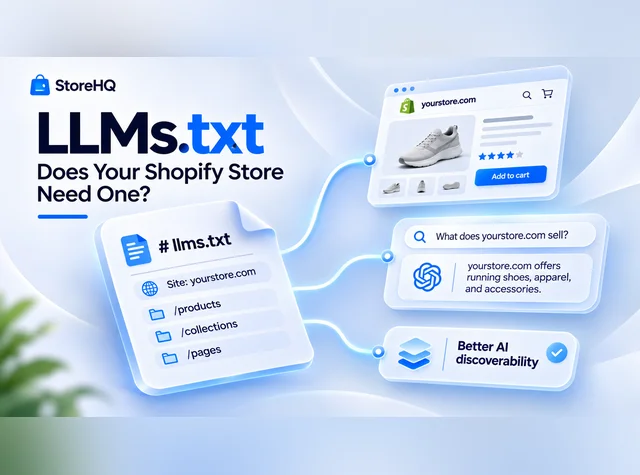
llms.txt is a Markdown file that gives AI agents a clearer overview of a website and points them to useful information.
Websites are built for people. Navigation, scripts, and product grids can make it harder for an AI agent to quickly identify what matters. llms.txt gives it a simpler starting point.
For an ecommerce store, that could mean links to policies, store information, or other useful resources.
The file provides context. It does not make products rank or replace clear product data and useful content.
Does Your Shopify Store Already Have LLMs.txt?
For most Shopify brands, yes.
Shopify now automatically serves /agents.md, /llms.txt, and /llms-full.txt. By default, they can return information such as your store name, URL, sitemap, policies, and other discovery endpoints.
Shopify treats /agents.md as the canonical discovery URL. The two llms URLs support agents that look for those conventions, and Shopify says you do not need a third-party app simply to generate them.
Before using an llms.txt generator, check what your store already serves and whether anything important is missing.
Shopify explains the current setup in its agent discovery documentation.
LLMs.txt Does Not Control AI Crawlers
It is easy to think of llms.txt as robots.txt for AI. That is not how the two files work.
llms.txt helps an agent find useful information. Crawler access is handled separately. On Shopify, robots.txt can communicate whether specific AI crawlers should access parts of the open website.
So if an AI crawler cannot reach an important page, adding that page to llms.txt does not fix the access problem.
This is why StoreHQ’s GEO approach looks beyond one file. AI visibility also depends on crawler access, structured data, useful content, citations, and trust signals.
What Should an LLMs.txt Example Include?
A useful llms.txt example is usually simpler than brands expect.
It may include your store name, a short business description, and links to resources an agent may need, such as shipping, returns, policies, FAQs, or important store pages.
The goal is not to list every URL. Your sitemap already serves a different purpose.
Think of llms.txt as a curated path through the information that matters most, not another long list of pages.
Do Shopify Brands Need to Customize LLMs.txt?
Some stores may benefit from customization when important information is hard to find or the default file does not represent the business clearly enough.
But customization should solve a specific problem.
If product titles are vague, attributes are incomplete, schema is missing, or important pages are difficult to crawl, rewriting llms.txt is unlikely to be the highest-impact fix.
The same principle applies across ecommerce growth. Find the bottleneck first. A broader ecommerce growth audit can separate a real technical gap from another new task.
What Matters More Than LLMs.txt?
AI systems still need clear, reliable information about what you sell.
For Shopify brands, that means complete product data, useful product and collection pages, structured data, consistent pricing, clear policies, reviews, and credible information beyond your own website.
It also means checking whether AI crawlers can access the store and whether your products appear for the questions shoppers ask.
The technology may change how products are discovered, but the foundation stays similar: make your store easy to access, understand, compare, and trust.
AI adds another discovery path without replacing the fundamentals that already help ecommerce stores get found. The difference between these two journeys becomes clearer when you look at how Google Search and AI Search shape product discovery.
Frequently Asked Questions
Is llms.txt the same as robots.txt?
No. llms.txt gives AI agents context and useful links. robots.txt communicates crawler access rules.
Does llms.txt help a Shopify store rank in ChatGPT?
There is no guaranteed ranking benefit. AI visibility depends on broader content, product, technical, and authority signals.
Does Shopify create llms.txt automatically?
Yes. Shopify currently serves /llms.txt and /llms-full.txt, along with its canonical /agents.md discovery URL.
Do I need an llms.txt generator for Shopify?
Usually not. Check the files Shopify already provides first, then customize only if there is a clear reason.
Treat LLMs.txt as Infrastructure, Not the Strategy
llms.txt can make useful information easier for AI agents to find, but it cannot compensate for a store that is hard to crawl, poorly structured, or missing key product context.
If you are unsure where AI systems may be missing your products, start a conversation with StoreHQ and get a clearer view of the gaps affecting your Shopify store’s AI discoverability.

 8 min read