

Blog
Cost Guide
Shopify Paid Advertising Cost in 2026: Budgets, ROAS & Strategy
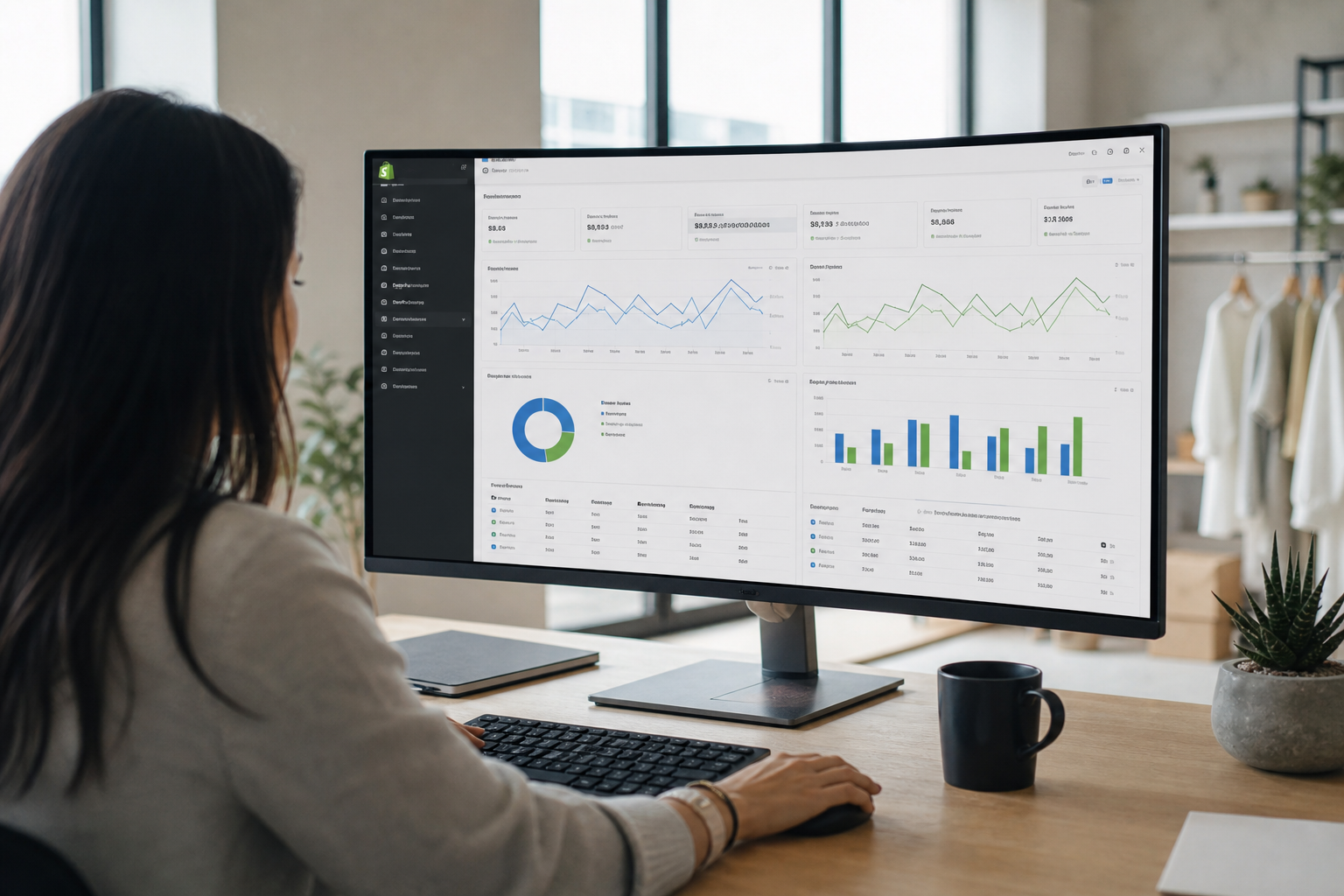
Shopify paid advertising costs more than most store owners expect going in. Between ad platform spend, creative production, agency fees, and tool subscriptions, the real number is rarely what a quick Google search suggests.
In 2026, Shopify brands running paid advertising across Google, Meta, and other platforms are spending anywhere from $1,500 to $50,000+ per month depending on their category, margins, and growth stage. The wide range isn't vague hedging. It reflects how differently a lean DTC startup and a scaling 7-figure brand approach the same channels.
This guide breaks down every cost layer: what drives prices up or down, what lean versus robust budgets actually buy, the line items most buyers miss, and two real-world budget scenarios with itemized numbers. If you're trying to figure out how much to spend on paid ads for your Shopify store, the answer is here.
What Does Shopify Paid Advertising Actually Cost in 2026?
The honest answer is: it depends on three things. Your category's competition level, your average order value, and how much of the work you're doing yourself versus handing to an agency. Those three variables explain most of the spread between a $1,500/month beginner budget and a $50,000/month performance budget.
Ad platform costs are only one slice of the total. A Shopify store running Google Shopping and Meta Ads also needs creative assets, a product feed manager, landing pages built for conversion, and someone to actually optimize the campaigns. Each of those has a price tag. Ignoring them is why so many Shopify stores conclude that paid advertising doesn't work when the real problem was an undercosted setup.
For context: Google Ads average cost-per-click for ecommerce keywords ranges from $0.88 to $2.50 (Google Ads benchmark data, 2024). Meta Ads average CPM ranges from $8 to $25 depending on audience targeting, creative quality, and time of year (Meta Ads Manager benchmarks, 2024). TikTok Ads minimum daily budget starts at $50/day at the campaign level (TikTok for Business, 2024).
- Early-stage stores (under $500K/year revenue): $1,500 to $5,000/month total paid advertising budget
- Growth-stage stores ($500K to $2M/year): $5,000 to $15,000/month across 2 to 3 channels
- Scaling brands ($2M to $10M/year): $15,000 to $50,000/month with multi-channel coverage
- Enterprise DTC ($10M+/year): $50,000 to $200,000+/month with full-funnel paid strategy
- Agency management fees add $1,500 to $8,000/month on top of ad spend, depending on scope
- Creative production (static, video, UGC) adds $500 to $5,000/month depending on volume
Six Cost Drivers That Push Your Shopify Ad Spend Up or Down
Not every Shopify store pays the same rates or gets the same returns. Six variables explain most of the difference between a profitable paid advertising program and one that burns budget without traction.
Competition level in your product category is the most powerful lever. Branded supplement companies and fashion brands in saturated niches face CPCs and CPMs two to three times higher than stores in less competitive verticals (WordStream ecommerce PPC benchmarks, 2024). Your margin structure determines whether those costs are survivable.
Conversion rate is the silent cost driver most brands underestimate. A store converting at 1% needs roughly twice the ad spend to generate the same revenue as a store converting at 2%. Fixing conversion rate issues on your landing pages before scaling ad spend is one of the highest-leverage moves available to any Shopify brand.
- Product category competition: high-demand verticals like supplements, apparel, and electronics carry premium CPCs
- Average order value (AOV): a higher AOV allows a higher cost-per-click and still returns profit
- Store conversion rate: every 0.5% improvement in CVR materially lowers effective customer acquisition cost
- Campaign structure quality: poorly structured Google Shopping feeds and Meta ad sets waste 20% to 35% of budget on irrelevant traffic (NEEDS_SOURCE)
- Channel mix: Google Ads typically delivers stronger purchase intent; Meta Ads drives stronger top-of-funnel volume at lower CPM
- Seasonality and auction competition: Q4 CPMs on Meta can spike 40% to 70% above Q2 baselines (Meta seasonal benchmarks, 2023)
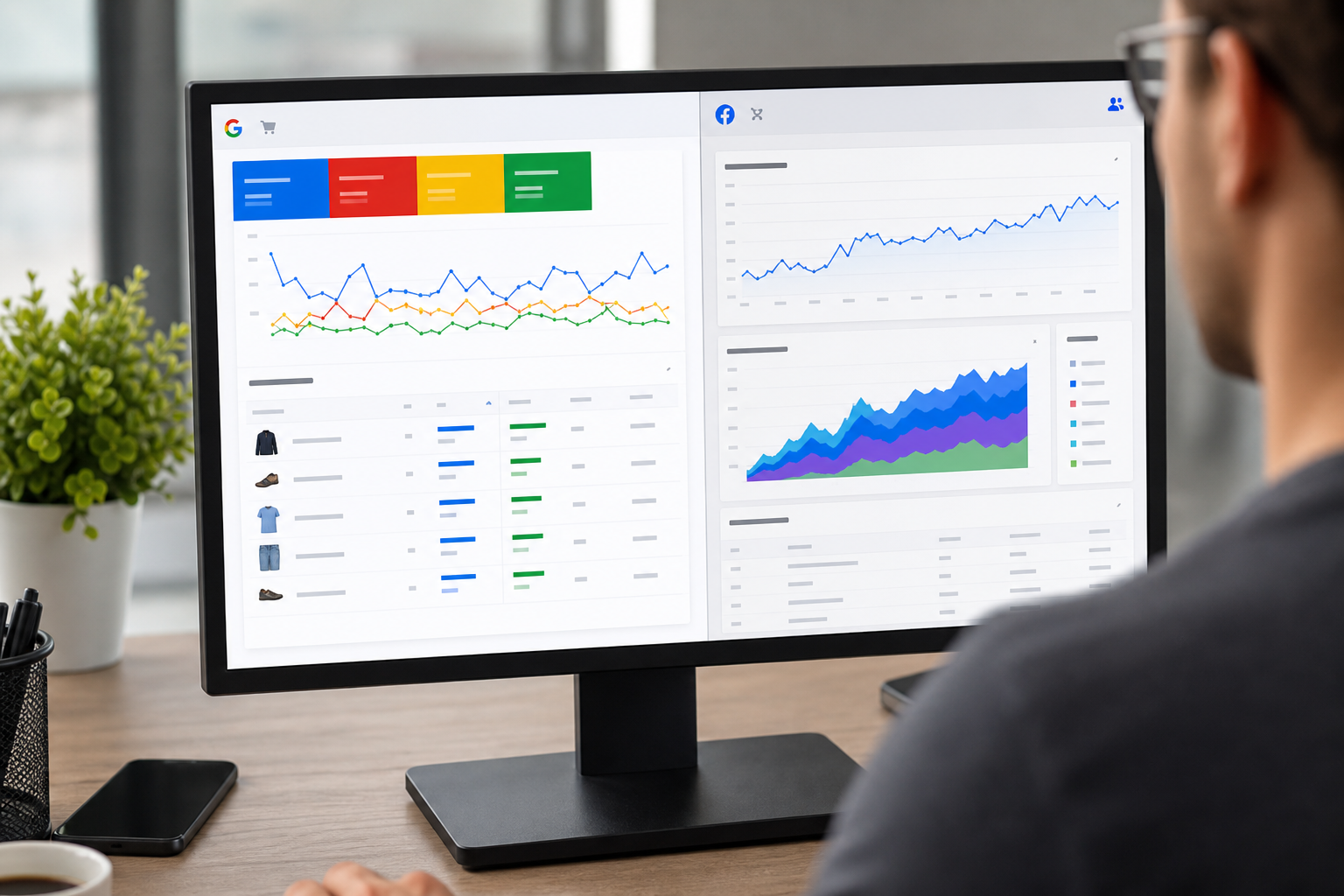
Three Budget Tiers: Lean, Standard, and Robust Shopify Ad Programs
Budget tier isn't just about how much you spend. It determines which channels you can activate, how much creative testing you can run, and whether you have enough data volume to optimize campaigns meaningfully. Below is what each tier realistically buys in 2026.
A lean budget is enough to prove a channel works and generate initial purchase data. It is not enough to run simultaneous Google Ads, Meta Ads, and TikTok Ads campaigns with proper testing. Brands at this tier should prioritize one or two channels and optimize depth before breadth.
A robust budget unlocks full-funnel coverage: prospecting, retargeting, Google Shopping, Performance Max, Meta Advantage+, and paid social video. At this level, the quality of campaign management and creative strategy determines outcomes more than raw spend volume.
- Lean ($1,500 to $5,000/month): one primary channel, limited creative testing, basic campaign structure
- Standard ($5,000 to $15,000/month): two channels, A/B creative testing, dedicated product feed management
- Robust ($15,000 to $50,000/month): full-funnel multi-channel, UGC creative pipeline, weekly optimization cadence
- Tier selection should reflect AOV and margin, not just revenue stage
- Underfunding a robust channel strategy produces worse results than a focused lean approach
Two Example Budgets: Itemized Shopify Paid Advertising Scenarios
Abstract ranges are useful. Concrete examples are better. Below are two representative Shopify store scenarios with fully itemized monthly budgets based on realistic 2026 market rates.
Scenario A is a DTC beauty brand doing $600K/year in revenue with a $55 AOV and a 2.1% store conversion rate. They want to prove Google Shopping and Meta Ads before scaling. Total monthly budget: $7,200 to $9,500. Breakdown: Google Shopping ad spend $2,500, Meta Ads spend $2,000, creative production 4 assets/month $800, feed management tool $100, agency management fee $2,500, attribution tooling $150. Expected outcome at a 3x ROAS: $13,500 in attributed revenue from $4,500 in platform spend.
Scenario B is a scaling home goods brand at $3.2M/year in revenue with a $120 AOV and a 2.8% store conversion rate. They are running Google Shopping, Performance Max, Meta Advantage+, and TikTok Ads. Total monthly budget: $32,000 to $38,000. Breakdown: Google Ads spend $10,000, Meta Ads spend $9,000, TikTok Ads spend $4,000, creative production 12 assets/month $3,600, landing page CRO retainer $1,500, feed management $200, agency management fee $6,000, attribution and analytics stack $500. Expected outcome at a 4x blended ROAS: $92,000 in attributed revenue from $23,000 in platform spend.
- Scenario A total monthly cost: $7,200 to $9,500 for a $600K/year beauty brand
- Scenario A platform spend: $4,500/month across Google Shopping and Meta Ads
- Scenario B total monthly cost: $32,000 to $38,000 for a $3.2M/year home goods brand
- Scenario B platform spend: $23,000/month across Google, Meta, and TikTok
- In both scenarios, agency and tooling costs represent 35% to 45% of total budget
- Blended ROAS targets: 3x for Scenario A, 4x for Scenario B, consistent with industry benchmarks for their AOV tiers
Shopify Paid Ads Management: Agency vs. In-House vs. Hybrid
How you staff the paid advertising function is itself a significant cost decision. Each model carries different tradeoffs between cost, speed, and performance ceiling.
In-house management costs $55,000 to $90,000/year in salary for a mid-level performance marketer in the US (Bureau of Labor Statistics, 2024), plus tools, training, and management overhead. The advantage is deep brand context. The limitation is that one person rarely has equal depth in Google Ads, Meta Ads, TikTok Ads, and creative strategy simultaneously.
Agency management typically ranges from $1,500 to $8,000/month depending on scope and ad spend volume. Specialized Shopify paid advertising agencies bring channel expertise, creative testing infrastructure, and benchmark data across dozens of accounts. StoreHQ, for example, has managed over $40M in ad spend across 200+ Shopify stores since 2016, giving their team pattern recognition that a single in-house hire takes years to develop. A hybrid model, where an in-house generalist owns strategy and an agency executes channel-level optimization, often delivers the best cost-to-performance ratio for brands spending $10,000 to $30,000/month.
- In-house hire: $55,000 to $90,000/year salary plus tools; best for brands with complex brand voice needs
- Agency model: $1,500 to $8,000/month; best for brands prioritizing channel expertise and speed to optimization
- Hybrid model: $3,000 to $5,000/month agency retainer plus part-time in-house; optimal for $10K to $30K/month spenders
- Freelancer model: $1,000 to $3,000/month; lowest cost but highest management burden and consistency risk
- Shopify-specialized agencies outperform generalist agencies on feed management, Shopping campaigns, and ROAS benchmarking
| Budget Component | Lean ($1,500–$5,000/mo) | Standard ($5,000–$15,000/mo) | Robust ($15,000–$50,000/mo) |
|---|---|---|---|
| Google Ads Spend | $500–$1,500 | $2,000–$5,000 | $8,000–$18,000 |
| Meta Ads Spend | $500–$2,000 | $2,000–$6,000 | $7,000–$15,000 |
| TikTok / Pinterest Ads | Not activated | $500–$1,500 | $3,000–$8,000 |
| Creative Production | $200–$500/mo | $800–$2,000/mo | $2,500–$7,500/mo |
| Feed Management Tools | $0–$100/mo | $100–$200/mo | $200–$300/mo |
| Agency / Management Fee | $0–$1,500/mo | $1,500–$3,500/mo | $4,000–$8,000/mo |
| Attribution & Analytics | $0–$100/mo | $100–$300/mo | $300–$500/mo |
| Channels Active | 1–2 | 2–3 | 3–5 |
| Expected Blended ROAS | 1.5x–2.5x | 2.5x–4x | 3.5x–6x+ |
| Best For | Proof of concept, early-stage DTC | Growth-stage Shopify stores | Scaling 7-figure DTC brands |
Frequently Asked Questions
-
How much does Shopify paid advertising cost per month?
Shopify paid advertising costs range from $1,500/month for early-stage stores to $50,000+/month for scaling DTC brands. The total includes platform ad spend, creative production, feed management, and agency fees. Most growth-stage Shopify stores operating across two channels spend between $5,000 and $15,000 per month in total. -
What is the average ROAS for Shopify paid campaigns?
Average ROAS for Shopify paid campaigns sits between 2x and 5x depending on product category, AOV, and campaign maturity. Fashion and beauty brands with strong creative and optimized landing pages can reach 6x or higher. Brands with low AOV, poor conversion rates, or under-optimized feeds typically see ROAS below 2x regardless of spend volume. -
Are paid ads profitable for Shopify stores?
Paid ads are profitable for Shopify stores when AOV, conversion rate, and margins support the cost-per-acquisition. A store with a $100 AOV and 40% gross margin can afford a CAC of roughly $25 to $30 and still generate profit. Profitability breaks down when conversion rates are below 1.5% or when CPCs rise faster than AOV growth. -
What is the difference between Google Ads and Facebook Ads for Shopify stores?
Google Ads captures existing purchase intent through Shopping and Search campaigns, making it stronger for bottom-of-funnel conversions. Facebook and Instagram Ads (Meta) generate demand through visual creative, making them more effective for audience building and top-of-funnel prospecting. Most Shopify stores above $5,000/month in budget benefit from running both channels simultaneously. -
Why are my Shopify ads not converting customers?
The most common causes are a weak landing page experience, audience targeting misalignment, low creative quality, or a product feed with incomplete data. A campaign sending qualified traffic to a product page with poor mobile UX or missing trust signals will consistently underperform regardless of how well the ad itself is optimized. CRO and ad optimization should run together. -
How do I lower my Shopify advertising cost per acquisition?
Lower CAC by improving store conversion rate, tightening audience targeting, improving creative relevance scores, and eliminating low-performing ad sets before scaling. Increasing AOV through bundles or upsells also lowers effective CAC without changing ad spend. Brands that combine paid advertising with CRO and SEO typically see CAC decline 25% to 40% over 12 months. -
Should I manage Shopify paid ads myself or hire an agency?
Self-management makes sense below $3,000/month in ad spend if you have time to learn platform mechanics. Above that threshold, the opportunity cost of under-optimization typically exceeds agency fees. Shopify-specialized agencies bring benchmark data, creative infrastructure, and feed management expertise that in-house generalists take 12 to 18 months to develop independently. -
Why is my Google Shopping feed underperforming?
Google Shopping underperformance most often traces back to poor product feed quality: missing attributes, weak product titles, incorrect pricing data, or suppressed listings due to policy issues. A feed missing strong keyword-rich titles and accurate categorization loses auction placements to competitors with cleaner data. Auditing feed completeness is the first step before adjusting bids or budgets.