

Blog
Cost Guide
How Much Does Shopify Paid Advertising Cost in 2026?
Running paid ads on a Shopify ecommerce store is one of the fastest ways to drive qualified traffic. But the question most founders and marketing managers ask first is the same: how much is this actually going to cost?
The honest answer is a range. Shopify paid advertising costs depend on your ad platform mix, your product category, your target market, and how much of the work you hand off to an agency versus manage in-house. A DTC beauty brand scaling from six to seven figures will spend very differently than a home decor Shopify store testing its first Google Ads campaign.
This guide breaks down every layer of that cost: the media spend itself, agency or management fees, creative production, platform differences, and the line items most brands miss until they see an unexpected charge. Every major figure is cited or flagged where data is limited, so you can build a budget grounded in reality, not guesswork.
What Drives Shopify Paid Advertising Costs Up or Down
No two Shopify ecommerce businesses pay the same rate for paid ads. Six core drivers determine where your total cost lands on the spectrum, and understanding them is the first step to building a budget that holds.
Platform choice alone creates significant variance. Google Ads (Search and Shopping) tends to carry higher CPCs than Meta Ads but reaches shoppers with higher purchase intent. Meta Ads Manager and Facebook ads deliver broader top-of-funnel reach at lower click costs, but typically require more creative investment to perform.
Your product category and average order value (AOV) are the other major levers. High-AOV categories like electronics or luxury goods can justify $3.00+ CPCs because a single conversion covers the cost. Low-AOV categories like consumables need tighter CPCs and higher conversion rates to stay profitable.
- Platform mix: Google Search, Google Shopping, Meta (Facebook/Instagram), TikTok, and Pinterest all carry different CPCs and setup costs.
- Product category: Competitive verticals like beauty, apparel, and electronics push CPCs higher due to auction density.
- Average order value (AOV): Higher AOV gives you more room to absorb ad spend before hitting a negative ROAS.
- Target geography: CPCs in the United States and Canada run materially higher than equivalent campaigns in India or other emerging markets (Google Ads Benchmark Report, 2024).
- Campaign maturity: New campaigns require a learning budget before algorithms optimize; expect 30 to 90 days of higher CPAs early on.
- Management model: Self-managed campaigns have no agency fee but require significant time and expertise; agency-managed campaigns add 10% to 20% of spend in fees (NEEDS_SOURCE).
Three Budget Tiers: Lean, Standard, and Robust Paid Advertising
The comparison table below shows what a Shopify ecommerce store realistically gets at each budget level. These figures reflect total monthly investment, combining media spend and management fees.
A lean budget is appropriate for stores testing a new channel or validating product-market fit. It limits you to one or two campaigns and narrow audience targeting. Expect limited data volume and slower optimization cycles.
A robust budget unlocks full-funnel coverage: prospecting, retargeting, Shopping campaigns, and dynamic creative testing across both Google and Meta platforms. This is where $40M+ in managed ad spend consistently produces a 4x+ ROAS for well-structured accounts (StoreHQ internal data, 2024).
- Lean ($1,500 to $3,000/month total): One platform, one campaign type, minimal creative, limited audience segmentation.
- Standard ($3,000 to $10,000/month total): Two platforms, prospecting and retargeting, basic creative testing, monthly reporting.
- Robust ($10,000 to $50,000+/month total): Full-funnel, multichannel, dynamic creative, weekly optimization, dedicated account management.
- Media spend typically represents 70% to 80% of the total budget at lean tiers and 80% to 90% at robust tiers as management efficiency improves.
- Brands scaling from six to seven figures in Shopify revenue generally operate in the $8,000 to $25,000/month range (NEEDS_SOURCE).
Two Example Budgets: Real Scenarios with Itemized Numbers
Abstract ranges only go so far. The two scenarios below show how a real Shopify paid advertising budget gets assembled, line by line, for two common store profiles.
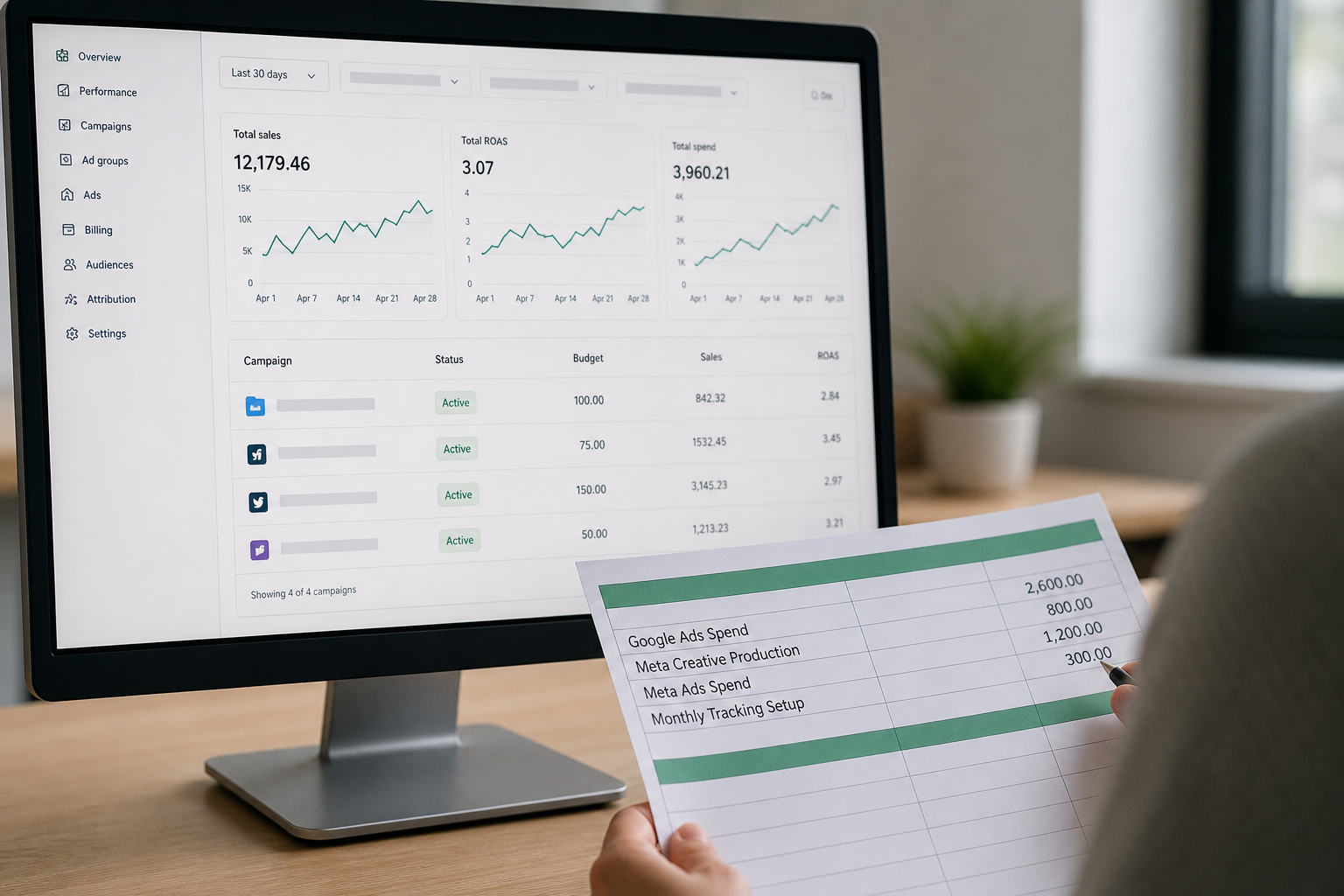
Scenario 1 is a mid-stage fashion and apparel Shopify store in the United States, with an AOV of $85, targeting a $5,000/month total budget. Media spend: $4,000 (Google Shopping $1,500, Meta prospecting $1,500, Meta retargeting $1,000). Agency management fee: $750 (flat rate, entry-level). Creative refresh: $250/month (licensed static templates). Total: $5,000/month. At a 3x ROAS on the $4,000 media spend, expected revenue attribution is $12,000/month from paid channels.
Scenario 2 is a scaling DTC beauty brand in Canada, AOV $120, targeting a $20,000/month total budget. Media spend: $16,000 (Google Search $3,000, Google Shopping $4,000, Meta prospecting $5,500, Meta retargeting $2,500, TikTok test $1,000). Agency management fee: $3,000 (percentage-of-spend model at roughly 18%). Creative production: $800/month (video and UGC refresh). Attribution tool: $200/month. Total: $20,000/month. At a 4x ROAS on media spend, expected paid revenue attribution: $64,000/month.
- Scenario 1 (Fashion, US, $5K/month): $4,000 media + $750 management + $250 creative = $5,000 total; projected 3x ROAS.
- Scenario 2 (Beauty, Canada, $20K/month): $16,000 media + $3,000 management + $800 creative + $200 attribution = $20,000 total; projected 4x ROAS.
- A $20/day Google Ads budget ($600/month) is generally too low for ecommerce unless targeting extremely narrow, high-intent keywords in a low-competition niche.
- Minimum viable Google Ads budgets for Shopify ecommerce stores are generally $1,000 to $1,500/month in media spend to exit the learning phase and generate meaningful data.
- Scaling ad spend without first optimizing landing pages and Shopify conversion rate optimization reduces effective ROAS regardless of channel or platform.
Platform-by-Platform Cost Benchmarks for Shopify Stores
Different paid advertising platforms carry different cost structures. The figures below represent 2024 ecommerce benchmarks and should be treated as starting points, not guarantees, since actual CPCs vary by category, competition, and creative quality.
Google Search Ads for ecommerce keywords average $0.83 to $2.85 CPC depending on category (WordStream Ecommerce Benchmarks, 2024). Google Shopping campaigns typically run lower CPCs of $0.50 to $1.20 but require a well-structured product feed and optimized Shopify product descriptions. Performance Max campaigns blend both and are increasingly the default structure in Google Ads for Shopify stores.
Meta Ads (Facebook and Instagram) average CPCs of $0.40 to $1.20 for ecommerce audiences, with CPMs ranging from $7 to $18 depending on audience size and creative relevance score (Meta Business Insights, 2024). TikTok ads for ecommerce run $0.50 to $1.00 CPC on average but require short-form video creative, which adds production cost.
- Google Search (ecommerce): $0.83 to $2.85 average CPC (WordStream, 2024).
- Google Shopping: $0.50 to $1.20 average CPC; feed quality is a major performance lever (WordStream, 2024).
- Meta Ads (Facebook/Instagram): $0.40 to $1.20 average CPC; $7 to $18 average CPM (Meta Business Insights, 2024).
- TikTok Ads: $0.50 to $1.00 average CPC; minimum daily budget $20/ad group (TikTok for Business, 2024).
- Pinterest Ads: $0.10 to $1.50 average CPC; strongest for home decor Shopify stores and lifestyle categories (Pinterest Business, 2024).
- Retargeting campaigns across all platforms consistently deliver 2x to 5x higher ROAS than cold prospecting, making budget allocation to retargeting a high-priority decision (NEEDS_SOURCE).
Agency vs. In-House vs. Hybrid: Three Management Cost Models
How you manage campaigns is a cost decision as much as a capability decision. Each model carries a different fee structure, time commitment, and performance risk.
In-house management eliminates agency fees but requires a skilled performance marketer with active knowledge of Google Ads, Meta Ads Manager, and feed management. Fully loaded salary for a mid-level paid media manager in the US ranges from $65,000 to $95,000/year (Bureau of Labor Statistics, 2024), which is only economical if your total monthly ad spend justifies a dedicated hire.
Agency management typically runs 10% to 20% of ad spend with a minimum monthly fee of $1,000 to $2,500 for smaller accounts, scaling to flat retainers of $3,000 to $8,000/month for larger budgets (NEEDS_SOURCE). StoreHQ, for example, has managed $40M+ in ad spend across 200+ Shopify stores since 2016, combining performance marketing with AI-powered campaign analysis to improve efficiency over time.
- In-house: No management fee, but $65,000 to $95,000/year in salary costs; best for brands spending $20,000+/month in media (BLS, 2024).
- Agency (percentage model): 10% to 20% of monthly media spend; aligns agency incentives with budget growth (NEEDS_SOURCE).
- Agency (flat retainer): $1,000 to $8,000+/month; more predictable cost for brands with stable budgets (NEEDS_SOURCE).
- Hybrid model: In-house manager for strategy and reporting, agency for creative and technical execution; common at $10,000 to $30,000/month spend levels.
- Freelance paid media specialists: $50 to $150/hour or $1,500 to $4,000/month; suitable for single-platform management on tighter budgets (NEEDS_SOURCE).
| Budget Tier | Monthly Total | Platforms Covered | What's Included | Typical ROAS Range |
|---|---|---|---|---|
| Lean | $1,500 to $3,000 | 1 platform (Google Shopping or Meta) | 1 to 2 campaigns, basic targeting, minimal creative, monthly report | 2x to 3x (NEEDS_SOURCE) |
| Standard | $3,000 to $10,000 | Google + Meta | Prospecting and retargeting, creative testing, Shopping feed, bi-weekly optimization | 3x to 4.5x (NEEDS_SOURCE) |
| Robust | $10,000 to $50,000+ | Google + Meta + TikTok or Pinterest | Full-funnel campaigns, dynamic creative, weekly optimization, attribution reporting, dedicated manager | 4x to 6x+ (NEEDS_SOURCE) |
Frequently Asked Questions
-
How much should a small business spend on Google Ads per month?
A small ecommerce business should plan for a minimum of $1,000 to $1,500/month in Google Ads media spend to generate enough data for meaningful optimization. Budgets below $600/month rarely exit the algorithm's learning phase. Most small Shopify stores find the $1,500 to $3,000/month range is the minimum viable starting point for measurable results (Google Ads Help, 2024). -
Is $20 a day good for Google Ads for a Shopify store?
$20 a day ($600/month) is generally too low for a Shopify ecommerce store running Google Ads. At that spend level, most campaigns lack the daily conversion volume needed for Smart Bidding algorithms to optimize effectively. A more realistic starting budget is $35 to $50/day per campaign, especially in competitive categories like fashion, beauty, or electronics (Google Ads Help, 2024). -
Why did Google Ads charge me $500 unexpectedly?
Google Ads uses a threshold billing system. When your account accrues charges that reach a preset billing threshold ($25, $50, $200, or $500), Google automatically charges your payment method. This is not an error. As your account spends more, the threshold increases. You can review and adjust billing settings directly inside your Google Ads account under Billing and Payments. -
What is a realistic ROAS for Shopify paid advertising?
A realistic ROAS benchmark for Shopify paid advertising ranges from 2x to 4x for most ecommerce categories, though high-AOV or low-competition niches can exceed this. New campaigns in the learning phase often run below 2x for the first 30 to 60 days. StoreHQ reports an average 4.8x ROAS across managed accounts, but results vary significantly by category, creative quality, and landing page performance. -
What is the difference between paid advertising on Google vs. Meta for Shopify?
Google Ads (Search and Shopping) captures high-intent shoppers who are actively searching for products, typically delivering higher conversion rates but higher CPCs. Meta Ads (Facebook and Instagram) reaches broader audiences based on interest and behavior targeting, with lower CPCs but typically requiring more creative testing. Most scaling Shopify ecommerce stores run both platforms together for full-funnel coverage. -
What are paid advertising platforms available for Shopify stores?
The primary paid advertising platforms for Shopify stores are Google Ads (Search, Shopping, Performance Max), Meta Ads (Facebook and Instagram), TikTok Ads, Pinterest Ads, and Microsoft Ads (Bing Shopping). Each platform suits different product categories: Google Shopping for high-intent buyers, Meta for lifestyle and impulse products, Pinterest for home decor Shopify stores, and TikTok for younger demographics with strong visual creative. -
How much do agencies charge to manage Shopify paid advertising?
Agency fees for Shopify paid advertising management typically run 10% to 20% of monthly media spend with a minimum fee of $1,000 to $2,500/month for smaller accounts. Larger accounts on flat retainers pay $3,000 to $8,000+/month. Freelance specialists charge $50 to $150/hour. The right model depends on your total media spend, campaign complexity, and internal team capacity (NEEDS_SOURCE). -
What hidden costs should I budget for in Shopify paid advertising?
Beyond media spend, Shopify paid advertising budgets should account for creative production ($500 to $3,000+ per batch), landing page and conversion rate optimization work ($1,000 to $5,000+ one-time), tracking and attribution tool setup ($500 to $2,000), and agency management fees (10% to 20% of spend). These hidden costs can add 20% to 40% to the advertised media spend figure (NEEDS_SOURCE).