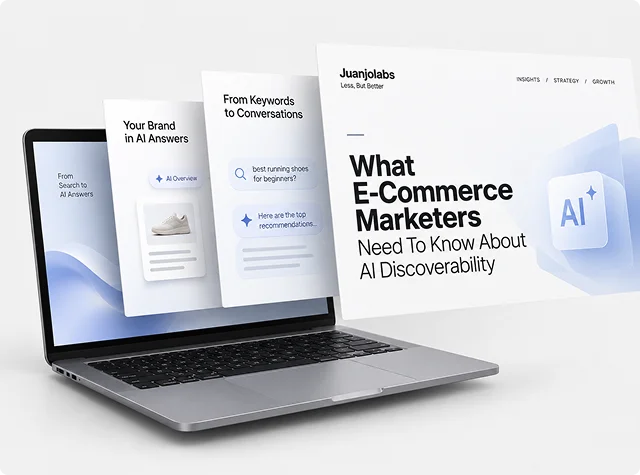
Shoppers aren’t starting their product searches the way they used to. Instead of typing keywords into Google and scanning the results, more people are turning to ChatGPT, Perplexity, Gemini, and Google’s AI-powered search experiences to research what to buy. That shift is quiet, fast, and already affecting e-commerce brands that haven’t changed a single thing about their marketing.
In this blog, we cover what AI discoverability means for e-commerce marketers, how AI systems decide which products to surface, and what brands can do to improve visibility across structured data, content, reviews, and product discovery channels.
AI Discovery Is Changing Where Shoppers Start Their Journey
ChatGPT, Perplexity, and Google AI Overviews have become real product discovery touchpoints. A shopper looking for the best running shoes for flat feet or a lightweight stroller within a certain price range asks AI directly and gets a recommendation without ever visiting the search results page. That recommendation may or may not include your brand.
The traditional keyword-driven search funnel assumed shoppers would click, compare, and browse product pages. AI search compresses that process. Shoppers get curated answers based on what AI systems trust, and brands that haven’t optimized for that environment are losing e-commerce AI visibility without having done anything wrong by old standards.
How AI Systems Actually Decide What to Show
AI shopping experiences don’t simply reproduce traditional search rankings. Depending on the platform, they can draw from product data, structured metadata, web content, reviews, merchant feeds, and other sources to determine which products are relevant to a shopper’s request.
Social proof carries real weight here. Reviews can influence how products are evaluated in AI-powered shopping experiences, while third-party mentions give systems additional context beyond what a brand says about itself. Context and shopper intent also matter. An AI answering a specific question looks for content that addresses the use case directly, not content that simply contains the right words.
Why Traditional SEO Isn’t Enough Anymore
Ranking on page one of Google and appearing in an AI-generated answer require different inputs. Traditional SEO focuses on backlinks, keyword placement, and crawlability. AI SEO depends more on structured data quality, semantic clarity, and authority signals that extend well beyond your own site.
Zero-click discovery adds complexity. When a shopper gets what they need from an AI-generated result without clicking through, there is no website session for your analytics platform to attribute, even though your brand may still have influenced the decision. You may be influencing purchase decisions with no measurable traffic to show for it. Most e-commerce marketing strategies aren’t built to handle that attribution blind spot.
The dark funnel, where shoppers research using AI before arriving at your site through direct traffic or a branded search, is growing. Brands that don’t account for it will consistently undervalue top-of-funnel efforts and misread which channels are actually driving conversions.
What E-Commerce Brands Need to Optimize for AI Visibility
AI visibility depends on more than showing up in search. E-commerce brands need to make their product information easy to read, easy to verify, and easy to match with real shopper intent. That means cleaning up structured data, strengthening product feeds, answering buyer questions directly, and building enough trust signals off-site for AI systems to recognize the brand as credible.
Structured Data and Product Feed Quality
Schema markup for products, reviews, and pricing gives AI systems the structured signals they need to represent your brand accurately. Without it, AI models interpret your pages on their own, and gaps in that interpretation lead to misrepresentation or omission. Clean, complete product feeds across your site, Google Merchant Center, and third-party channels reduce the likelihood that your products will be passed over.
Data gaps are where AI discoverability breaks down most often. Missing attributes, outdated pricing, or inconsistent product names across feeds give AI systems reason to deprioritize your listings in favor of brands with cleaner data.
Content That Answers Real Shopper Questions
Intent-driven content is better suited to the natural-language questions shoppers ask AI tools than copy written around exact-match keywords alone. Product descriptions and category pages that explain use cases, solve specific problems, and address common questions give AI systems more to work with when matching your products to shopper intent.
FAQ-style content mirrors how shoppers phrase questions to AI assistants. A shopper asking “what’s the best moisturizer for dry skin in winter” isn’t typing a keyword. Building content that reflects that natural question structure gives your brand a better shot at appearing in the generated answer.
Brand Authority and Social Proof
Review volume and recency are AI trust signals. A brand with hundreds of recent, detailed reviews reads as more credible to an AI system than one with a handful of older ratings. Mentions across editorial content, forums, and third-party sites further reinforce that authority.
Consistent brand information across all channels also matters. When your brand name, product names, and key details appear the same way everywhere, AI systems can connect those signals more reliably and represent your brand accurately in generated outputs.
How to Start Measuring AI-Driven Visibility
Tracking AI discoverability means looking beyond standard analytics. Start by monitoring brand mentions and product appearances in AI-generated outputs, either manually or through tools built for this purpose. Check whether your brand appears in responses from ChatGPT or Perplexity for relevant product queries.
Dark funnel signals are worth watching closely. Spikes in direct traffic, increases in branded search volume, and growth in assisted conversions can all indicate that AI-assisted discovery is happening before your measurable touchpoints. StoreHQ helps brands connect these signals across search, reviews, product data, and conversion paths, making AI visibility easier to track and act on. Adjusting your attribution models to account for that pre-visit research gives you a more accurate picture of what’s actually driving revenue in AI search ecommerce conditions.
Book a demo to see where your biggest growth opportunities lie.
Frequently Asked Questions
What is AI discoverability in e-commerce?
It refers to whether your products appear in AI-generated answers and recommendations across tools like ChatGPT, Perplexity, and Google AI Overviews when shoppers ask product-related questions.
Is AI SEO different from traditional SEO?
Yes. AI systems prioritize structured data, semantic relevance, and authority signals over keyword density and backlink volume alone. The optimization inputs differ, even though some fundamentals overlap.
Do I need to change my entire e-commerce marketing strategy for AI search?
Not entirely. Strong fundamentals still apply, but layering in structured data, conversational content, and brand authority work is what keeps you visible in AI-driven discovery.
How do I know if AI is driving traffic or sales to my store?
Watch for increases in direct traffic, branded search volume, and assisted conversions. Use tools that track AI referral sources where available, and treat these signals as indicators of upstream AI influence.
AI Discoverability Is Now Part of E-commerce Growth
AI discoverability is already shaping how shoppers find products. Brands that treat it as a present-day priority are building an advantage over those still optimizing purely for traditional search. The starting points are clear: audit your structured data, sharpen your product content, and consistently build review volume.
Get a growth audit with StoreHQ to see how your e-commerce brand appears across AI search, product discovery, reviews, and structured data signals.

 6 min read