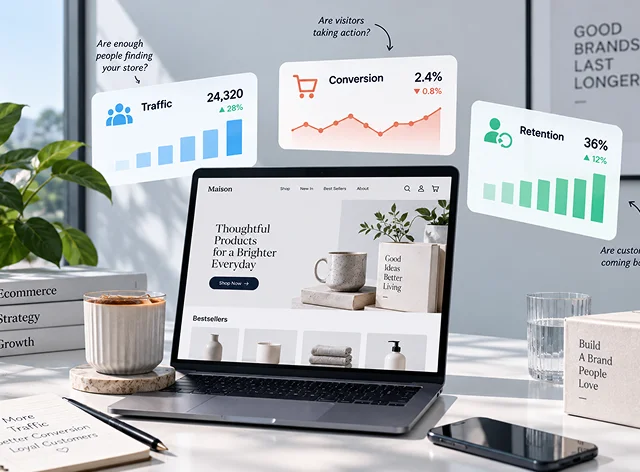
Many e-commerce brands assume the answer is always more traffic. If sales are slow, the instinct is to spend more on ads, launch more campaigns, or chase more reach. But growth problems are not always acquisition problems. Sometimes the store is getting enough visitors and failing to convert them. Sometimes it is converting well but not bringing buyers back. That is why the first step in ecommerce growth is not scaling. It is a diagnosis.
The fastest way to find the real bottleneck is to look at the full customer journey. A store can have strong traffic and still underperform because product pages are weak. It can have solid conversion and still stall because repeat purchases are too low. A simple ecommerce funnel analysis helps you see where the leak is before you spend more money trying to fill it.
Why Ecommerce Growth Problems Are Often Misdiagnosed
A lot of brands misread the symptom as the problem. When revenue slows down, traffic becomes the obvious culprit because it is the easiest metric to watch. Sessions are visible. Ads are visible. Campaigns are visible. But visibility does not mean effectiveness.
This is where brands often waste budget. They increase spend before they understand where customers are dropping off. They add more media, more email sends, or more content without knowing whether the issue is awareness, consideration, or retention. The result is more activity but not necessarily more growth.
The better approach is to diagnose first and scale second. A quarterly growth audit helps identify the bottleneck, then decide which lever matters most. That is usually a better use of time than guessing which channel needs more fuel. It also keeps teams from solving the wrong problem at the wrong stage.
Is Your Problem Traffic or Conversion?
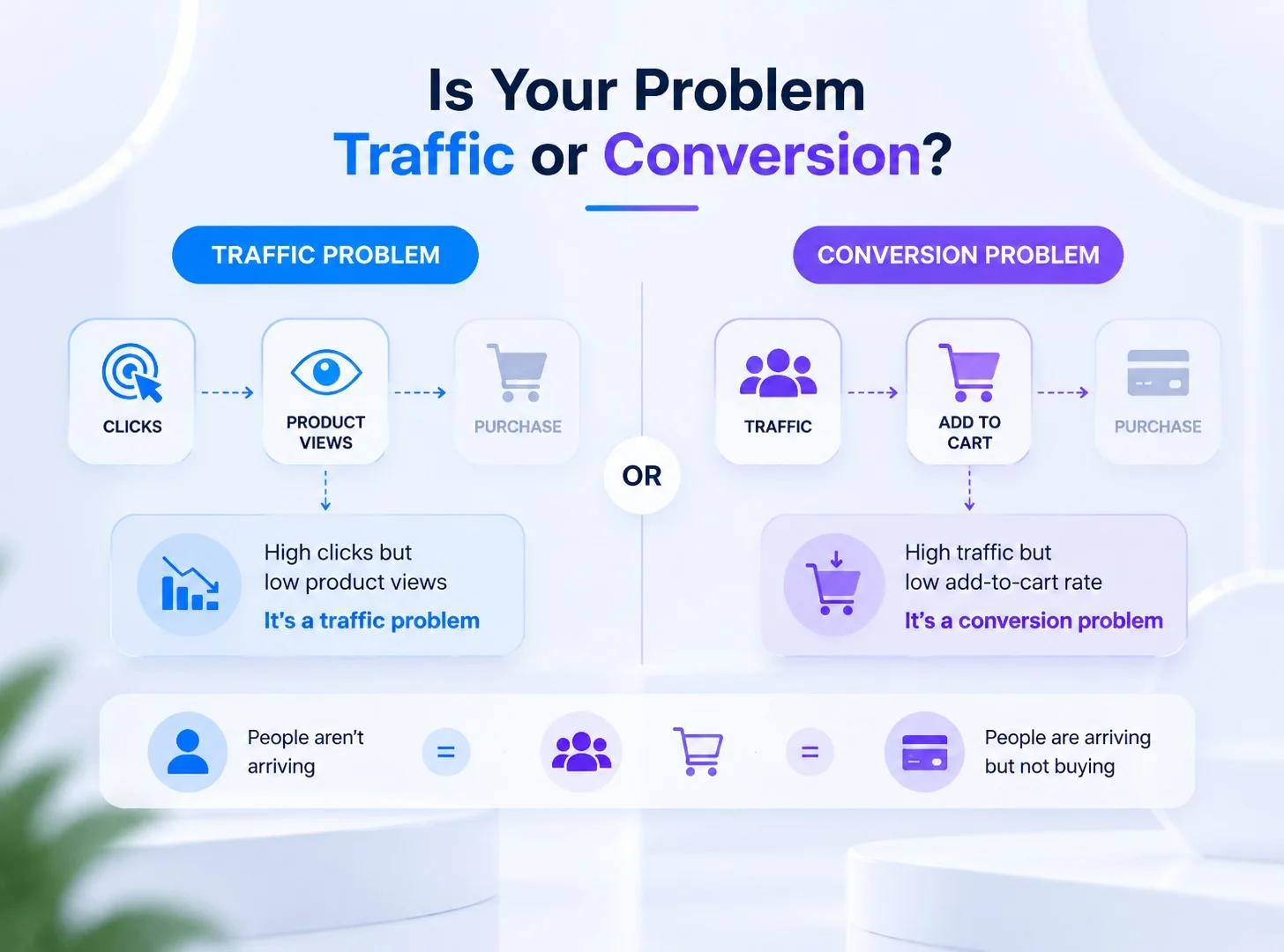
The clearest way to think about ecommerce traffic vs conversion is to ask whether people are not arriving, or arriving and not buying. Traffic issues happen before qualified visitors reach the store, while conversion issues happen after they land.
A traffic problem usually means low sessions, weak reach, or poor audience fit. A conversion problem means people visit product pages but still do not buy, often because of unclear value, weak trust, or friction in the purchase path.
Here’s a simple test , if clicks are high but product views are low, it is usually traffic. If traffic is strong but add-to-cart rates are weak, it is usually conversion.
How To Identify Conversion Rate Problems
Conversion rate issues usually become obvious once shoppers start interacting with your store. Common signs include:
- Low add-to-cart rates despite healthy product page traffic.
- Unclear product pages that don’t answer key customer questions or communicate value effectively.
- Confusing pricing or shipping costs that reduce purchase intent.
- Checkout friction, such as mandatory account creation, lengthy forms, or limited payment options.
- Poor mobile experience, including difficult navigation, slow load times, or hard-to-use checkout flows.
- High cart or checkout abandonment, indicating trust or usability issues.
- Weak trust signals, such as missing reviews, guarantees, return policies, or security badges.
- Paid campaigns with low conversion rates, where traffic arrives but fails to generate sales.
- Creative fatigue in ads, shown by declining CTR, rising CPMs, and lower engagement.
Tip: Follow the customer journey from product view → add to cart → checkout → purchase. The stage with the biggest drop-off usually reveals where your conversion problem lies.
Why Retention Problems Can Limit Ecommerce Growth
Retention is often the most underestimated part of ecommerce growth. A store can win the first sale and still struggle if customers never come back.
If repeat purchases are weak, the business has to keep replacing lost buyers, which puts more pressure on paid channels and acquisition efficiency. Over time, that makes growth more expensive and less stable.
That is why customer lifetime value matters so much. A store with strong retention grows more efficiently because each customer is worth more over time. Retention issues usually show up when first-time buyers convert but do not become repeat buyers, often because the post-purchase experience or follow-up is too weak.
Building A Strong Ecommerce Retention Strategy
An effective retention strategy focuses on delivering relevant, timely experiences that encourage customers to return. Key elements include:
- Personalized email and SMS campaigns based on customer behavior and purchase history.
- Welcome flows that introduce your brand and set clear expectations.
- Post-purchase sequences that build confidence, provide support, and encourage repeat purchases.
- Replenishment reminders for products customers are likely to reorder.
- Reactivation campaigns to win back inactive customers with relevant offers or content.
- Customer segmentation based on purchase frequency, product type, and shopping behavior.
- Simple, valuable loyalty programs that reward repeat purchases without unnecessary complexity.
- Product education and helpful content that keeps customers engaged after their first order.
- Consistent post-purchase experience, including excellent service, timely communication, and ongoing value.
A successful retention strategy keeps customers engaged long after their first purchase, increasing customer lifetime value and reducing reliance on constant customer acquisition.
How To Decide What Your Store Actually Needs
The decision becomes easier when you look at the pattern of the business instead of a single metric. If you have very low traffic, the problem is likely acquisition. If you have traffic but weak sales, the problem is likely conversion. If you have sales but poor repeat purchase behavior, the problem is likely retention.
This is where the right growth approach matters. Broader guidance can help, but only after you know which part of the funnel needs attention first. A store that lacks traffic should not spend its energy on checkout optimization alone. A store with plenty of visitors but weak sales should not keep buying more traffic before fixing the product experience. A store with repeat buyers but weak acquisition may need stronger discovery and visibility.
The point is to match the fix to the bottleneck. That is what makes ecommerce conversion rate optimization effective in practice. It is not just about improving the rate. It is about improving the part of the journey that is limiting the store’s growth right now.
A simple rule helps. If visitors are coming but not buying, focus on conversion. If buyers are coming back too rarely, focus on retention. If people are not arriving at all, focus on traffic. Once that diagnosis is clear, every next decision gets easier.
Conclusion
Most stores do not have a single growth problem. They have one dominant bottleneck that keeps showing up first. Some stores need more traffic. Some need stronger conversion. Others need a better retention system. The job is not to guess. The job is to identify where the leak is and fix that stage before adding more pressure to the rest of the funnel.
That is why ecommerce funnel analysis should sit at the center of your decision-making. It helps you see whether the issue is traffic, conversion, or retention, and it keeps you from overspending on the wrong lever. More advanced perspectives on quarterly growth audits reinforce the same idea: diagnose cleanly, then scale with intent. When you do that, ecommerce conversion rate optimization becomes a growth system, not just a tactic.
Ready to scale smarter? Get a growth audit with StoreHQ and turn your optimization process into a consistent competitive advantage.

 6 min read