

Blog
Complete Guide
The Complete Guide to Ecommerce Email Marketing
Email is the highest-ROI channel most ecommerce brands are still under-using. For every dollar spent, email marketing returns an average of $36 to $42, yet many Shopify store owners treat it as an afterthought behind paid ads.
This guide covers everything you need to build an ecommerce email marketing strategy that actually drives revenue: the foundational concepts, the must-have automated flows, how to grow your list, which tools to choose, and where most brands go wrong.
Whether you are launching a new retail or ecommerce store or trying to fix a Shopify email marketing setup that is not driving sales, this resource gives you the full map. Deeper specialist content is linked throughout each section.
The goal is not to send more emails. The goal is to send the right email to the right person at the right moment in their buying journey.
What is ecommerce email marketing?
Ecommerce email marketing is the practice of using targeted, automated, and campaign-based emails to engage shoppers, recover lost revenue, and drive repeat purchases across the full customer lifecycle. It spans one-time promotional campaigns and always-on automated flows triggered by shopper behavior such as browsing, cart abandonment, or a completed purchase. Unlike broadcast advertising, ecommerce email marketing speaks directly to a known contact with personalized content tied to their history with your store.
Why Email Marketing Still Matters for Ecommerce Brands
Email is a first-party channel, meaning you own the list. Unlike paid social or organic search, no algorithm change can cut your reach overnight. That ownership makes email the most resilient revenue channel in a Shopify brand's marketing mix.
Does email marketing still matter for small ecommerce businesses? The data says yes. Small DTC brands consistently report that email drives 20% to 40% of total store revenue, often outperforming Google Ads and Meta Ads on a cost-per-revenue basis.
Digital marketing in ecommerce has grown more expensive every year as ad platforms raise CPMs. Email lets you re-engage customers you already paid to acquire, compressing customer acquisition costs over time and lifting lifetime value.
- Email delivers an average ROI of $36 to $42 per dollar spent across ecommerce verticals
- First-party ownership means no dependency on ad platform algorithm changes
- Repeat buyers acquired via email typically have 2x to 3x higher lifetime value than single-purchase customers
- Email personalization based on purchase history outperforms generic batch-and-blast sends by 20% to 30% in revenue per recipient
- SMS and email used together outperform either channel alone, but email remains the higher-volume workhorse
What Is the Ecommerce Email Marketing Framework?
An ecommerce email marketing framework organizes your sends into two distinct tracks: automated flows and campaign emails. Flows run 24/7 in the background, triggered by shopper behavior. Campaigns are intentional, scheduled sends to a segment or your full list.
Flows generate revenue passively. Campaigns create urgency around launches, promotions, and seasonal moments. The healthiest programs balance both, with flows covering the retention layer and campaigns driving spikes around key calendar dates.
The 80/20 rule in email marketing applies directly here: roughly 80% of your email revenue will come from 20% of your sends, usually your core automated flows and a handful of high-relevance campaigns. Build the 20% first before optimizing the rest.
- Track 1: Automated flows (behavior-triggered, always-on revenue)
- Track 2: Campaign emails (scheduled, list-wide or segmented sends)
- The 80/20 rule: prioritize the 5 highest-impact flows before scaling campaign volume
- Segmentation by purchase frequency, category affinity, and engagement tier is the foundation of the framework
- Every send maps to a lifecycle stage: acquisition, activation, retention, or winback
- Ecommerce email marketing templates should be modular so campaigns can be built in under an hour
Five Core Automated Flows Every Shopify Store Needs
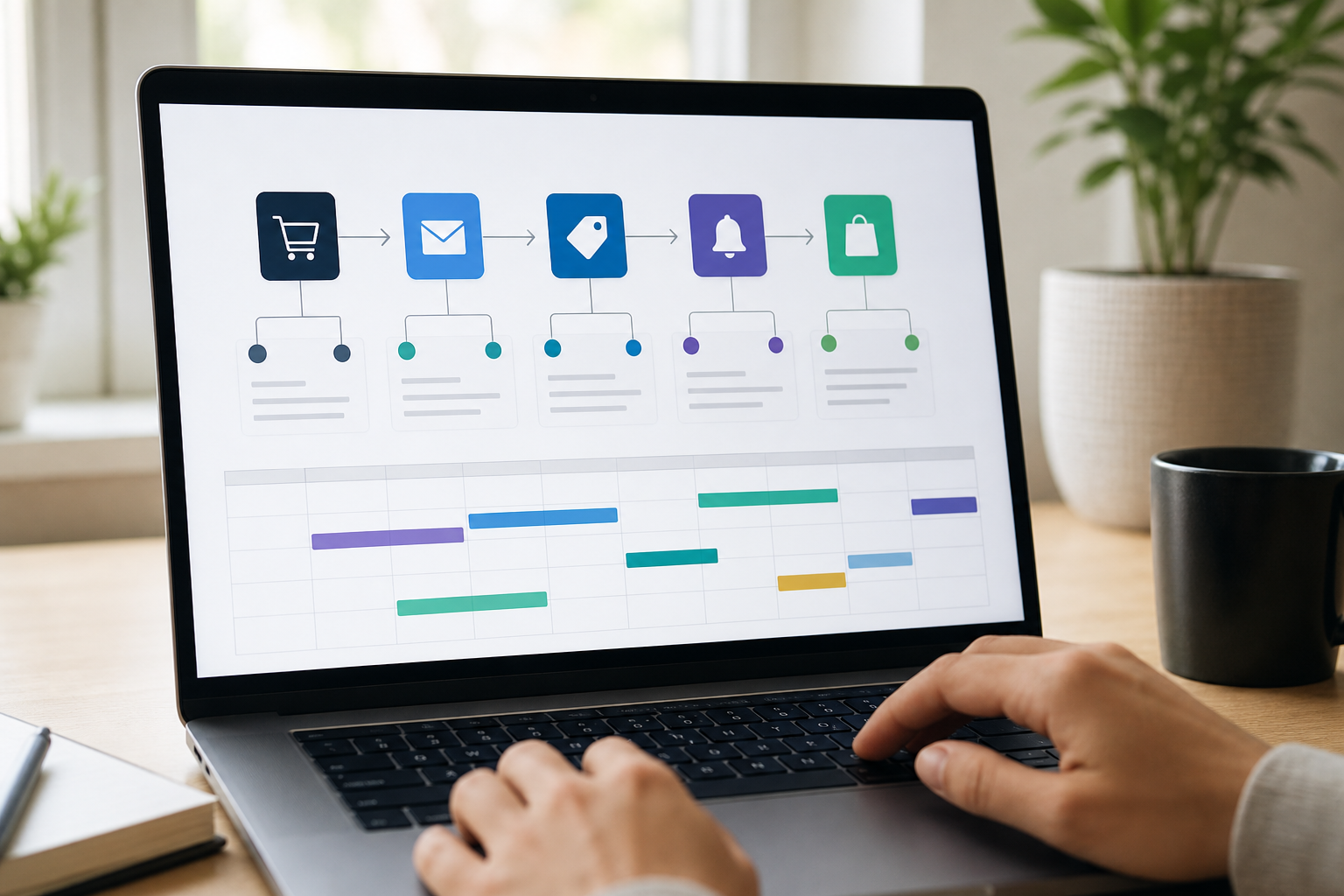
Automated flows are the engine of an ecommerce email marketing strategy. They run without manual effort and capture revenue at every stage of the customer journey. If your Shopify email marketing is not driving sales, missing or under-optimized flows are usually the cause.
Each flow below should be treated as a minimum viable program. Most high-performing Shopify stores run 8 to 12 distinct flows, but these five are the non-negotiable starting point for any ecommerce email marketing strategy for Shopify.
In email marketing, an onboarding email (also called a welcome email) is the first message a subscriber receives after opting in. It sets expectations, introduces the brand, and often delivers a first-purchase incentive. Welcome flows with 3 to 5 emails consistently outperform single-email welcome sends.
- Welcome / Onboarding flow: Introduce the brand, deliver the opt-in offer, and convert the first purchase
- Abandoned cart flow: Recover the 70%+ of shoppers who add to cart but do not complete checkout
- Post-purchase flow: Confirm the order, set expectations, cross-sell, and request a review
- Browse abandonment flow: Re-engage shoppers who viewed products but did not add to cart
- Winback flow: Re-engage lapsed customers who have not purchased in 90 to 180 days
How to Grow an Email List for a Small Ecommerce Store
List growth is not a one-time project. It is an ongoing acquisition channel that should be treated with the same rigor as paid traffic. A healthy Shopify store should be converting 2% to 5% of monthly site visitors into email subscribers.
The most effective list growth tactics combine an exit-intent popup with an always-visible inline signup form and a strong lead magnet. The offer matters as much as the placement. A percentage discount typically outperforms free shipping in head-to-head tests for fashion and beauty brands.
For new retail and ecommerce stores with limited traffic, partnerships and social-to-email funnels accelerate early list building. Running a giveaway in collaboration with a complementary brand can add hundreds of qualified subscribers in days.
- Exit-intent popups with a clear offer convert 2% to 8% of visitors on average
- Gated content, product quizzes, or waitlists attract high-intent subscribers beyond discount seekers
- Post-purchase account creation prompts capture buyers who skip the pre-purchase popup
- Social media stories and link-in-bio CTAs drive list growth from existing audiences
- Referral programs reward current subscribers for bringing in new contacts
- A/B test popup timing, offer type, and copy quarterly to sustain conversion rates
Choosing the Best Ecommerce Email Marketing Tool
The best email marketing tool for ecommerce is one that integrates natively with Shopify, supports behavior-based segmentation, and allows multi-step automation logic. Feature parity between platforms has grown, so the real differentiator is how well the tool connects to your store's purchase data.
Klaviyo is the most widely adopted platform in the Shopify ecosystem because its data layer syncs purchase events, product catalog data, and customer attributes in real time. Mailchimp email marketing covers the basics but has historically lagged on ecommerce-specific segmentation depth. Newer entrants like Omnisend and Drip offer strong mid-market alternatives.
When evaluating the best ecommerce email platform, prioritize predictive analytics, revenue attribution reporting, and the ability to trigger flows from custom Shopify events. Pricing scales with list size on most platforms, so factor total contacts and send frequency into your cost model.
- Klaviyo: strongest Shopify-native integration, predictive LTV scoring, deep segmentation
- Omnisend: strong for combined email and SMS workflows at competitive pricing
- Drip: flexible visual automation builder, good for stores with complex product catalogs
- Mailchimp: accessible entry-level option but limited advanced ecommerce segmentation
- Postscript: SMS-first but integrates email for blended lifecycle programs
- Evaluate platforms on Shopify data sync depth, not just template design or send pricing
Three Campaign Types That Drive Ecommerce Revenue
Beyond automated flows, campaign emails create revenue spikes and deepen brand relationships. The highest-performing ecommerce email marketing campaigns fall into three categories: promotional, content-led, and lifecycle milestone campaigns.
Promotional campaigns include product launches, seasonal sales, and flash events. Content-led campaigns educate, entertain, or solve a problem tied to your product category. Milestone campaigns recognize a subscriber's anniversary, birthday, or loyalty tier. All three should reference real customer data to feel relevant rather than generic.
Looking at strong ecommerce email examples, the common thread is specificity. The best promotional emails feature one product or one offer, not five. The best content emails solve one problem. Clarity in a single email drives more clicks than comprehensiveness.
- Promotional campaigns: new arrivals, sales events, and limited-time offers with a clear deadline
- Content-led campaigns: how-to guides, ingredient explainers, or styling tips tied to your catalog
- Lifecycle milestone campaigns: birthday, loyalty anniversary, or tier upgrade recognition emails
- Segmented sends (to high-intent buyers only) outperform full-list blasts on promotional emails
- A/B test subject lines, preview text, and CTA button copy before scaling to your full list
- Batch-and-blast frequency above 4 to 6 sends per month risks deliverability and list fatigue
Common Mistakes in Shopify Email Marketing (and How to Fix Them)
Is email marketing actually a pain point for ecommerce brands? For many, yes, but the problems are usually structural, not technical. The most common issue is treating email as a broadcast channel rather than a personalized one. Sending the same message to your entire list ignores the purchase history, browsing behavior, and lifecycle stage of each contact.
A second major mistake is neglecting deliverability. Sending to unengaged contacts tanks your sender reputation, which reduces inbox placement for your best customers too. Clean your list quarterly by sunsetting contacts who have not opened in 180 days.
Shopify email marketing not driving sales is often a symptom of poor flow setup, not poor copywriting. Audit your flows first: check trigger conditions, send timing, and whether segments are filtering correctly before rewriting subject lines.
- Sending to your full list without segmentation lowers open rates and increases unsubscribes
- Skipping the sunset flow allows disengaged contacts to damage sender reputation over time
- Broken automation triggers are the most common reason flows fail to generate revenue
- Over-discounting trains subscribers to wait for promotions rather than buying at full price
- Not tracking revenue attribution per flow makes it impossible to know what to optimize
- Ignoring mobile rendering means up to 60% of your list sees a broken email experience
When to Work With an Ecommerce Email Marketing Agency
Scaling from 6 to 7 figures is the most common trigger for brands to hire an ecommerce email marketing agency. At that stage, the complexity of managing segmentation, flow logic, deliverability, and campaign calendars simultaneously exceeds what a single in-house marketer can handle without dropping execution quality.
A specialist ecom email marketing agency brings platform expertise, copywriting, design, and data analysis under one roof. For Shopify brands, working with an agency that also manages SEO, paid ads, and CRO means email strategy stays aligned with the wider acquisition and retention picture.
StoreHQ has worked with 200+ Shopify stores since 2016, founded by Stanford GSB and IIT alumni, building email programs that integrate with paid and organic channels rather than running in isolation. For brands searching for an ecommerce digital marketing agency or evaluating top ecommerce email marketing agencies, the right partner prioritizes revenue attribution and lifecycle strategy over template volume.
- Signs you need an agency: no automated flows live, email under 15% of total revenue, list growing but revenue flat
- Look for agencies with native Shopify integration experience, not general email service providers
- Evaluate case studies by revenue metrics (RPR, LTV, flow revenue) not just open rate benchmarks
- The best ecom email marketing agencies run flows and campaigns in parallel, not sequentially
- Ask prospective partners how they handle deliverability monitoring and list hygiene
- AI email marketing services for ecommerce are emerging, use AI for subject line testing, send-time optimization, and predictive segmentation
| Platform | Shopify Integration | Automation Depth | Best For | Starting Price |
|---|---|---|---|---|
| Klaviyo | Native, real-time sync | Advanced multi-step flows + predictive analytics | Mid-market to enterprise Shopify brands | Free up to 250 contacts, then usage-based |
| Omnisend | Strong native integration | Good email + SMS combined workflows | Stores wanting blended email and SMS | Free tier available, paid from ~$16/mo |
| Drip | Good via API | Flexible visual builder | Stores with complex multi-catalog setups | From ~$39/mo |
| Mailchimp | Basic integration | Limited ecommerce segmentation | Very early-stage stores on tight budgets | Free tier, paid from ~$13/mo |
| Postscript | Native Shopify | SMS-first, email secondary | Brands prioritizing SMS with email support | Usage-based, from ~$100/mo |
Frequently Asked Questions
-
What is ecommerce email marketing?
Ecommerce email marketing is the use of targeted, behavior-triggered, and campaign-based emails to engage shoppers and drive purchases across the customer lifecycle. It includes automated flows like welcome series and abandoned cart sequences alongside scheduled promotional campaigns. For Shopify brands, it is typically the highest-ROI owned channel, generating $36 to $42 per dollar spent on average. -
What is the 80/20 rule in email marketing?
The 80/20 rule in email marketing means roughly 80% of your email revenue comes from 20% of your sends, typically your core automated flows and a handful of high-relevance campaigns. This means new ecommerce brands should build and optimize the five core flows first before scaling campaign frequency. Prioritizing high-impact sends over volume is the faster path to revenue growth. -
What is the best email marketing tool for ecommerce?
Klaviyo is widely regarded as the best email marketing tool for ecommerce because of its native Shopify integration, real-time purchase data sync, and advanced segmentation capabilities. Omnisend is a strong alternative for brands that want combined email and SMS workflows at lower cost. The right platform depends on your list size, automation complexity, and whether you need SMS alongside email. -
How can I grow my ecommerce sales through email marketing?
Growing ecommerce sales through email starts with activating the five core automated flows: welcome, abandoned cart, post-purchase, browse abandonment, and winback. Beyond flows, segmenting your list by purchase history and sending relevant campaign emails around launches and promotions increases revenue per recipient. Brands that combine strong flows with bi-weekly campaigns consistently see email driving 20% to 40% of total store revenue. -
How do I grow an email list as a small ecommerce store?
The most effective tactics for small ecommerce stores are exit-intent popups with a clear offer, post-purchase account creation prompts, and social-to-email funnels from Instagram or TikTok. A well-designed popup converting 2% to 5% of site visitors can add hundreds of subscribers monthly even at modest traffic levels. Gated content like product quizzes or early access waitlists attract higher-intent subscribers than discount-only offers. -
How much does email marketing cost for an ecommerce brand?
Email marketing costs vary from near zero for small lists on free tiers to several thousand dollars per month for managed agency services at scale. Platform costs on Klaviyo or Omnisend typically run $100 to $1,500 per month depending on list size. Hiring an ecommerce email marketing agency for strategy, design, and execution adds $1,500 to $6,000 or more monthly, but well-run programs generate multiples of that in attributed revenue. -
What is an onboarding email in email marketing?
An onboarding email is the first message a new subscriber receives after joining your list, designed to introduce the brand, set expectations, and encourage a first purchase. In ecommerce, onboarding emails are usually part of a 3 to 5 email welcome flow rather than a single send. The welcome flow consistently ranks among the top two revenue-generating automated flows for Shopify stores. -
Is email marketing worth it for small ecommerce businesses?
Yes. Email marketing is one of the most cost-effective channels for small ecommerce businesses because it re-engages customers you already paid to acquire rather than spending on new acquisition. Even a list of a few thousand subscribers with strong automated flows can generate a meaningful share of monthly revenue. The key is setting up behavior-triggered flows before scaling campaign volume.