

Blog
Complete Guide
The Complete Guide to Social Media Marketing for Ecommerce Brands

Social media is where your customers discover products, compare options, and decide to buy. For ecommerce brands, that means every scroll is a sales opportunity — and every missed post is a competitor gaining ground.
But posting consistently and actually driving revenue are two very different things. Most Shopify store owners have tried social media and hit the same wall: decent follower counts, weak conversion rates, and no clear line between content effort and sales.
This guide covers the full picture — which platforms deserve your budget, how to build a social media strategy for ecommerce that converts, what the best content formats look like, and where most brands go wrong. Whether you're scaling from six to seven figures or launching your first paid social campaign, this is the map you need.
What Is Social Media Marketing for Ecommerce?
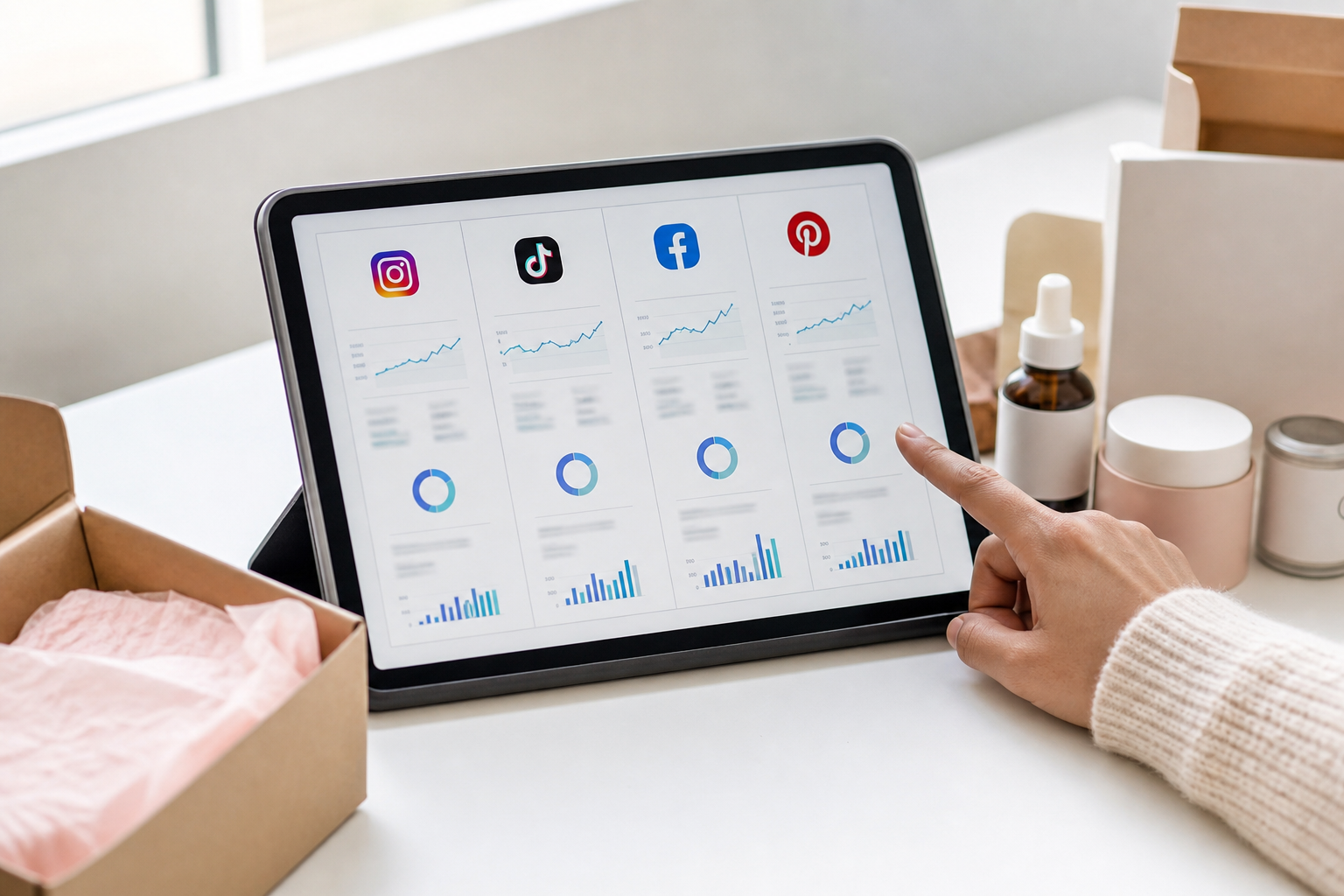
Social media marketing for ecommerce is the practice of using platforms like Instagram, TikTok, Facebook, and Pinterest to attract shoppers, build brand trust, and drive product sales for online stores. It combines organic content, paid social advertising, influencer and creator partnerships, and platform shopping features to move customers from discovery to purchase. Unlike general brand marketing, ecommerce social media strategy is measured against revenue outcomes: traffic, conversion rate, and return on ad spend.
What Is Social Media Marketing for Ecommerce?
Social media marketing for ecommerce is not just about brand awareness. It is a revenue channel — one that starts the moment a potential customer sees your product in their feed and ends when they complete a purchase on your Shopify ecommerce website.
The discipline sits at the intersection of content strategy, paid advertising, customer psychology, and platform mechanics. Each platform has its own algorithm, ad format, audience behavior, and shopping feature set. A strategy that works on Instagram may perform entirely differently on TikTok.
What unifies successful ecommerce social media programs is intent: every piece of content, every ad, and every creator partnership is built to move someone closer to a buying decision. Brand awareness is a means to that end, not the goal itself.
- Organic content builds brand trust and drives repeat visits from existing followers
- Paid social advertising scales reach and targets high-intent buyers beyond your current audience
- Creator and influencer partnerships introduce your product to warm, pre-qualified audiences
- Platform shopping features — Instagram Shops, TikTok Shop, Pinterest Product Pins — shorten the path to purchase
- User-generated content bridges the gap between social proof and paid creative
- Performance data from social channels feeds back into product positioning, pricing, and CRO
Five Best Social Media Platforms for Ecommerce Sales
Not every platform deserves equal investment. The best social media platforms for ecommerce sales are the ones where your specific customers spend time and where the platform's native shopping tools support the purchase journey you want to create.
Instagram remains the strongest platform for visual product categories — fashion, beauty, home goods, food, and fragrance. Its combination of Reels, Stories, Shopping tags, and a mature paid advertising ecosystem makes it the default starting point for most DTC brands. Instagram marketing strategy for ecommerce has evolved far beyond static posts: short-form video and shoppable content now drive the majority of discovery.
TikTok has closed the gap dramatically, particularly for brands targeting audiences under 35. TikTok Shop's in-app checkout and a creator ecosystem built around authentic product demonstrations have made it a genuine sales channel, not just a brand-building platform. The shopify TikTok marketing strategy for growth that works best emphasizes entertainment first, product second.
Facebook's organic reach has declined, but its paid advertising infrastructure — particularly retargeting, lookalike audiences, and catalog-based dynamic ads — remains one of the most cost-efficient tools for scaling a Shopify store. Pinterest consistently outperforms expectations for home, fashion, and food brands, where purchase intent is high and competition for ad placements is lower than on Meta properties.
- Instagram: strongest for visual DTC categories; mature ad platform; best for fashion, beauty, and home
- TikTok: highest organic reach potential; growing in-app commerce; strongest with under-35 audiences
- Facebook: lower organic value but unmatched for paid retargeting and lookalike audience campaigns
- Pinterest: high purchase intent; less competitive ad auction; strong for home, food, fashion, and seasonal products
- YouTube: growing shopping integration; ideal for product demos, reviews, and longer consideration cycles
How to Build a Social Media Strategy for Ecommerce Brands
A social media marketing strategy for ecommerce brands starts with a clear answer to one question: what does this channel need to produce for the business? Traffic, first-time purchases, repeat purchases, and brand equity all require different content approaches, platform mixes, and measurement frameworks.
Audience research comes before content planning. Map where your ideal customer spends time, what content formats they engage with, which creators they follow, and what problems or desires your product addresses. This work shapes everything downstream — from the tone of your captions to the hooks in your video ads.
From there, a working ecommerce social media strategy template covers four areas: platform selection and priority, content pillars and formats, posting cadence and a content calendar, and paid social integration. Organic and paid social should not operate as separate programs — they should share creative learnings, audience data, and messaging.
- Define the primary business goal for each platform before creating a single piece of content
- Build three to five content pillars that reflect your brand values and your customer's interests, not just your product catalog
- Set a realistic posting cadence you can sustain — consistency matters more than volume
- Create a feedback loop between organic engagement data and paid ad creative testing
- Document your strategy in a simple ecommerce social media content calendar to prevent gaps and last-minute posting
- Review performance monthly and adjust platform weighting based on actual revenue contribution
Three Core Content Formats That Drive Ecommerce Social Sales
Content format is one of the most consequential decisions in social media marketing for ecommerce. The same product can perform completely differently depending on how it is presented. Three formats consistently outperform across platforms and product categories.
Short-form video — Reels, TikToks, YouTube Shorts — now drives the majority of organic reach on every major platform. For ecommerce, the most effective short-form videos demonstrate the product in use, show a before-and-after transformation, or lead with a problem the product solves. The first two seconds determine whether a viewer stops scrolling.
User-generated content (UGC) is the highest-leverage asset most ecommerce brands underuse. Authentic customer videos and photos outperform brand-produced creative in paid social ads across nearly every product category. A structured user generated content strategy for Shopify ecommerce brands combines organic reposts with paid UGC ad creative, creating a content flywheel that compounds over time.
Static and carousel posts still have a role — particularly on Instagram and Pinterest — for showcasing product details, collections, and editorial content. They are less likely to reach new audiences algorithmically but remain valuable for converting followers who already have purchase intent.
- Short-form video: lead with a hook in the first two seconds; show the product in context, not just on a white background
- User-generated content: actively solicit reviews, unboxing videos, and styling photos; repurpose the best performers in paid ads
- Carousel posts: use for product comparisons, collection showcases, step-by-step use cases, and social proof compilations
- Live shopping: growing in the US after proving effective in Asian markets; strong for product launches and limited drops
- Stories and ephemeral content: best for flash sales, polls, and driving direct traffic to product pages via link stickers
Four Common Reasons Ecommerce Social Media Is Not Driving Sales
If your social media is not converting, the problem is almost always one of four things: wrong platform for your audience, content that builds awareness without creating purchase intent, a broken link between social and your Shopify store, or measuring the wrong outcomes.
The most common mistake is treating social media as a broadcast channel rather than a sales funnel. Posting product photos without context, calls to action, or a path to purchase creates followers, not customers. Every post should have a next step — whether that is a link in bio, a swipe-up, a product tag, or a direct reply prompt.
A weak landing page is often where the conversion breaks down. Traffic driven from social media lands on a product page that loads slowly, lacks social proof, or fails to match the energy of the ad or post that drove the click. Social media and ecommerce website performance are inseparable — one without the other leaks revenue.
Measurement errors compound over time. Brands that rely solely on last-click attribution undervalue top-of-funnel social content and over-invest in bottom-of-funnel retargeting. A blended attribution model that accounts for view-through and assisted conversions gives a more accurate picture of social's actual contribution to revenue.
- Wrong platform: investing in a channel your target customer does not actively use for product discovery
- Awareness-only content: posting without calls to action, product tags, or a clear path to purchase
- Landing page misalignment: social ad traffic hitting a slow, low-trust, or irrelevant product page
- Last-click attribution: undervaluing top-of-funnel social content that starts the purchase journey
- Inconsistent posting: gaps in the content calendar that cause algorithmic reach to drop and audience trust to erode
- No testing cadence: running the same creative for months without refreshing hooks, formats, or offers
Instagram vs TikTok for Ecommerce: Choosing the Right Primary Platform
Instagram vs TikTok for ecommerce is one of the most debated questions in DTC marketing — and the honest answer is that for most brands, it is not a binary choice. The stronger question is which platform should receive the majority of your organic content effort and paid budget.
Instagram has a more mature purchase journey. Shoppers use it to research brands, browse collections, and compare products before buying. The audience skews slightly older (25 to 44), average order values tend to be higher, and the path from Reel to purchase is well-established. Best practices for Instagram product promotion emphasize quality creative, consistent aesthetic, and a strong link-in-bio strategy.
TikTok excels at product discovery and impulse purchases. Its algorithm surfaces content to non-followers at a scale Instagram no longer matches organically, which gives new brands a faster path to initial reach. TikTok Shop's in-app checkout has made it a genuine sales channel in 2024 and 2025. The tradeoff is that creative has a shorter shelf life and content demands are higher.
Brands selling products in the $20 to $80 range with strong visual or demonstration appeal — beauty tools, kitchen gadgets, fitness accessories, apparel — typically see strong results on TikTok. Brands with higher AOV, a story-driven brand identity, or a design-forward product catalog often find Instagram a more productive primary channel.
- Instagram: stronger for high-AOV products, design-led brands, and audiences aged 25 to 44
- TikTok: stronger for impulse buys, product demonstrations, and reaching new audiences organically
- Both platforms support paid social advertising — test creative on organic before scaling with spend
- TikTok Shop supports in-app checkout; Instagram Shopping redirects to your Shopify store for most transactions
- Use platform-native formats — Reels on Instagram, Spark Ads on TikTok — rather than repurposing the same creative across both
- Evaluate platform performance by revenue contribution, not follower growth or engagement rate alone
When to Work With a Social Media Agency for Ecommerce Brands
Most Shopify founders and ecommerce managers start social media in-house. That makes sense at early stages when brand voice is still being defined and budget is limited. The inflection point where an agency partnership creates more value than cost typically arrives when paid social spend exceeds $5,000 to $10,000 per month, organic content demands exceed internal bandwidth, or ROAS is declining despite consistent spend.
The best social media agencies for ecommerce brands are not generalist digital marketing shops. The platforms, creative formats, shopping integrations, and attribution models that matter for ecommerce are different enough from B2B or service business marketing that vertical expertise matters significantly.
StoreHQ has worked with 200+ Shopify stores over 8 years, managing more than $40M in ad spend with a 4.8x average ROAS. The team combines paid social expertise with organic content strategy, creator partnerships, and Shopify-specific CRO — so social media performance connects directly to store conversion, not just traffic. That integration is what separates ecommerce-focused social media partners from agencies that treat every client the same way.
- Consider an agency when paid social spend exceeds $5,000 to $10,000 per month and ROAS is declining
- Look for ecommerce-specific experience — platform shopping integrations, catalog feed management, and DTC creative strategy are specialized skills
- Evaluate agencies by revenue outcomes they have produced for similar brands, not by follower counts or award lists
- A strong agency partnership includes both execution and strategy — not just ad management without creative or content input
- Ask prospective agencies how they connect social media performance to on-site conversion rate and AOV, not just traffic
| Platform | Best For | Organic Reach Potential | Paid Ad Strength | Native Shopping Feature |
|---|---|---|---|---|
| Fashion, beauty, home, luxury, DTC brands with strong visuals | Moderate (Reels-led) | Very High (Meta Ads Manager) | Instagram Shopping / Product Tags | |
| TikTok | Impulse buys, product demos, brands targeting under-35 | High (non-follower reach) | High (TikTok Ads Manager) | TikTok Shop (in-app checkout) |
| Retargeting, older demographics, catalog-based dynamic ads | Low (organic reach declined) | Very High (Meta Ads Manager) | Facebook Shops / Marketplace | |
| Home, food, fashion, seasonal products, high purchase intent | Moderate (search-driven) | Medium (lower competition) | Pinterest Product Pins / Shopping Ads | |
| YouTube | Product demos, reviews, longer consideration cycles | Moderate (search + suggested) | High (Google Ads integration) | YouTube Shopping (via Shopify) |
Frequently Asked Questions
-
How does social media help facilitate ecommerce?
Social media facilitates ecommerce by placing products in front of shoppers during passive browsing, creating discovery moments that search engines cannot replicate. Native shopping features on Instagram, TikTok, and Pinterest shorten the path from discovery to purchase. Social proof in the form of reviews, UGC, and creator content builds the trust needed for a first-time buyer to complete a transaction. -
What are the best social media platforms for ecommerce sales?
Instagram and TikTok consistently drive the most ecommerce sales for DTC brands, but the right platform depends on your product category, average order value, and target audience. Instagram suits higher-AOV, design-led products with audiences aged 25 to 44. TikTok outperforms for impulse-driven categories and younger demographics. Facebook remains essential for paid retargeting, and Pinterest delivers strong results for home, fashion, and food brands. -
Why is my ecommerce social media not driving sales?
The most common reasons are posting content without clear calls to action, targeting the wrong platform for your audience, and sending social traffic to a product page that does not convert. Weak landing page performance, last-click attribution errors, and inconsistent posting cadence also suppress results. Auditing the full path from social post to checkout — not just the content itself — usually reveals where revenue is being lost. -
How to grow a Shopify store with social media?
Growing a Shopify store with social media requires a coordinated strategy across organic content, paid social, and creator partnerships. Start by identifying the one or two platforms where your customers are most active. Build a consistent content calendar, test short-form video and UGC formats, and connect your Shopify product catalog to platform shopping features. Paid social amplifies what works organically — do not scale spend until you have validated creative that converts. -
What is the impact of social media on ecommerce trends?
Social media has fundamentally shifted product discovery from search engines to algorithmic feeds and creator content. Social commerce — purchasing directly within a social platform — is growing rapidly, with TikTok Shop and Instagram Shopping reducing friction in the purchase journey. Brands that built audiences on social media now have a distribution channel that operates independently of paid search costs, making it a significant competitive advantage. -
How much does social media marketing cost for ecommerce?
Social media marketing costs for ecommerce brands vary widely. Organic content management through an agency typically runs $1,500 to $5,000 per month depending on platform count and content volume. Paid social ad management fees are generally 10 to 15 percent of ad spend, on top of the media budget itself. Influencer campaigns range from gifting-only at low cost to $5,000 or more per creator post for mid-tier partnerships. -
What are the best practices for Instagram product promotion?
The most effective Instagram product promotion combines Reels-first content strategy, shoppable product tags, and a strong link-in-bio destination. Lead video content with a problem or transformation hook in the first two seconds. Use UGC and creator content alongside brand-produced creative. Post consistently to maintain algorithmic reach, and use Stories for time-sensitive offers, polls, and direct product page links via link stickers. -
How to turn social media followers into paying customers?
Converting followers into customers requires adding purchase intent to content that currently only builds awareness. Tag products in every applicable post, use Stories link stickers to drive traffic directly to product pages, and run retargeting ads to followers who have engaged but not purchased. Exclusive follower discounts, limited-time offers, and creator-led product demonstrations are among the highest-converting tactics for closing the gap between interest and purchase.
Social Media Influencer Marketing for Ecommerce: What Actually Works
Influencer marketing has matured past the era of chasing the highest follower counts. For ecommerce brands, the most consistent returns come from mid-tier and micro-creators — accounts with 10,000 to 200,000 followers — whose audiences are tightly aligned with a specific product category or lifestyle.
Follower count is the wrong primary metric. Engagement rate, audience demographics, past brand partnership performance, and content quality matter more. A creator with 30,000 highly engaged followers in a relevant niche will typically outperform a creator with 500,000 passive followers for driving actual purchases.
The mechanics that work: gifting campaigns for product seeding, affiliate commission structures that align creator incentives with sales, and paid amplification of top-performing creator content via Meta and TikTok ads. The last tactic — running the creator's video as a paid ad with their handle visible — consistently reduces cost-per-acquisition compared to brand-produced creative.