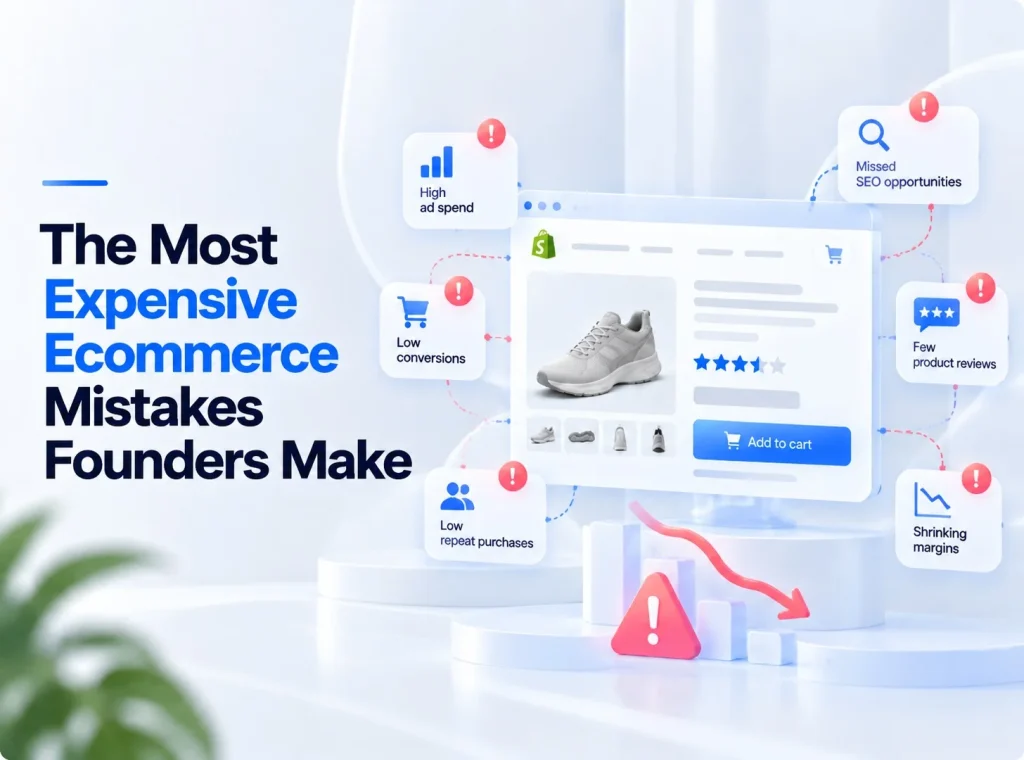
Most ecommerce stores don’t fail because of a bad product. They fail because of bad decisions made at the wrong time, often with good intentions. The mistakes that drain revenue fastest aren’t always visible at the moment. They show up later, in rising customer acquisition costs, shrinking margins, and stalled growth despite real effort.
This blog covers the high-stakes errors that consistently hurt ecommerce founders and what each one actually costs.
Scaling Paid Ads Before Fixing Conversions
Pouring more budget into paid ads before the store converts is one of the fastest ways to burn cash. If the product page is weak, the checkout process has friction, or the offer isn’t clear, then no campaign structure will fix the underlying problem. ROAS suffers not because the targeting is off, but because the destination isn’t doing its job.
CRO isn’t something you revisit after scaling. It’s a prerequisite. Moving the conversion rate from 1.5% to 2.5% on existing traffic changes the economics of every campaign running against the store. Founders who treat optimization as an afterthought pay for it directly in wasted budget and inflated acquisition costs. These are classic ecommerce scaling mistakes that show up fast once spend increases.
Ignoring Retention While Obsessing Over Acquisition
When CAC keeps climbing and the repeat purchase rate stays flat, the business is working harder than it needs to. Acquiring a new customer costs significantly more than selling to an existing one, yet many ecommerce brands have no structured retention strategy beyond a generic newsletter.
The lifecycle flows that drive the most revenue, abandoned cart sequences, post-purchase series, and win-back campaigns, are often missing entirely or set up once and never touched again. That’s money sitting idle. Ignoring retention while chasing new customers is one of the most common ecommerce growth mistakes, and it compounds quietly until CAC becomes unsustainable.
Treating SEO as Optional
Over-reliance on paid channels without an organic foundation is an expensive long-term position. Every sale driven purely by ads requires ongoing spend. SEO builds an asset that keeps delivering without a cost per click attached to every visit.
The most common SEO gaps in ecommerce are category pages with thin copy, product descriptions that duplicate manufacturer copy, missing schema markup, and a lack of an internal linking strategy. None of these are complex fixes, but they are constantly deprioritized. Starting SEO late is one of the more avoidable ecommerce marketing mistakes because the compounding nature of search visibility means every month of delay extends how long you’ll keep paying for traffic.
Skipping the Data Before Making Big Decisions
Scaling what feels right, rather than what the numbers show, is a pattern that costs ecommerce brands at every stage. Without clear visibility into channel performance, attribution, and product-level margin, budget allocation becomes guesswork. The result is spending more on channels that look productive on the surface but leak margin underneath.
Poor analytics doesn’t just waste budget. It delays pivots that could have entirely changed the business trajectory. Real-time tracking and proper attribution aren’t luxuries for common ecommerce challenges. They’re the difference between decisions that compound and decisions that quietly erode the business.
This is one of the ecommerce founder mistakes that’s easiest to avoid once the right setup is in place. StoreHQ helps ecommerce founders connect performance data across SEO, paid ads, reviews, retention, and conversion paths so they can see which mistakes are actually costing revenue before they scale the wrong thing.
Underestimating the Cost of a Poor Customer Experience
Slow site speed, confusing navigation, and checkout friction don’t just reduce conversion rate. They reduce LTV because a customer who had a poor first experience rarely comes back. No guest checkout option, limited payment methods, and unclear shipping information are friction points that show up directly as abandoned carts and one-time buyers.
One bad experience hits immediate revenue and long-term review scores at the same time. Customers who leave frustrated don’t write glowing reviews, and negative sentiment on product pages is visible to every future visitor. The cost isn’t just the lost sale. It’s the downstream damage to trust, which is one of the worst ecommerce founder mistakes to recover from.
Neglecting Social Proof and Reviews
Low review volume on high-traffic product pages is a conversion problem, not just a reputation problem. Shoppers use reviews as a decision signal, and a page with few or no reviews creates doubt regardless of how strong the product copy is.
Without a system to generate, manage, and respond to reviews, this gap won’t close on its own. Review generation needs to be a deliberate process built into the post-purchase flow. Responding to reviews, positive and negative, signals credibility to future buyers and affects how platforms surface your products. Treating trust signals as passive reputation management is one of the more common ecommerce growth mistakes, leaving measurable revenue on the table.
Book a demo to find the ecommerce mistakes costing your brand revenue, margin, and repeat customers.
Frequently Asked Questions
What is the most common ecommerce mistake new founders make?
Scaling paid ads before the store is optimized for conversion. Traffic without a converting site burns budget fast.
Why do ecommerce stores with high traffic still struggle to grow?
Usually a retention or CRO problem. Visitors aren’t converting, and buyers aren’t coming back. Both issues compound over time.
When should an ecommerce brand invest in SEO?
From day one, ideally. Category pages and product descriptions should be optimized early. SEO takes time to compound, so starting late means paying for traffic longer.
How do I know if my ecommerce marketing mistakes are hurting revenue?
Rising CAC, flat repeat purchase rate, and low ROAS are the clearest signals. A proper attribution setup makes these patterns visible before they become expensive.
Fix the Ecommerce Mistakes That Quietly Drain Growth
These mistakes are common because they’re easy to deprioritize when the business is moving fast. The fix isn’t doing more across every channel at once. It’s building smarter systems across SEO, CRO, retention, and analytics so each part of the business supports the others.
Get a growth audit with StoreHQ to uncover the ecommerce mistakes costing your brand revenue, margin, and repeat customers.

 6 min read